How Lake Oswego’s Wet Winters Affect Exterior Paint, Wood Siding and Trim
KEY FEATURES
- Lake Oswego-specific winter intent: Focuses on what prolonged wet weather does to an existing exterior rather than duplicating the fall application-window articles.
- Wood-forward content: Gives cedar, siding, trim, fascia and window casing more depth because wood conditions are central to this search intent.
- Moisture-path diagnosis: Helps homeowners understand that peeling paint may be the symptom rather than the original cause.
- Local wet-season context: Uses the City of Lake Oswego's October 1–May 31 construction wet-weather designation as local context without misrepresenting it as a painting regulation.
- Maintenance-before-repaint logic: Creates a natural conversion path into ECR, paint-failure assessment and LCC rather than turning every symptom into a repaint sale.
- Lake Oswego internal localization: The article naturally links to Lightmen's closest currently indexed Lake Oswego-specific content.
What Is Lake Oswego Winter Rain Doing to Your Exterior Paint?
Lake Oswego winters do not need hurricanes, blizzards or dramatic temperature extremes to be hard on a house exterior.
Rain can do plenty of work all by itself.
Then add:
- Shade
- Trees
- Moss
- Mildew
- Damp mornings
- Wet-dry cycles
- Failed caulk
- Exposed wood
- Gutters that aren't behaving
and suddenly a small paint defect in October can look much more interesting by March.
Exterior paint on a Lake Oswego home is doing more than making the house look finished.
It is part of the protective system covering:
- Siding
- Trim
- Fascia
- Window casings
- Doors
- Other exterior wood components
Lightmen's existing Lake Oswego house-painter guide already emphasizes that local homes can involve wood siding, detailed trim, shaded elevations, tree cover and substantial moisture exposure.
Winter is when those details matter most.
The problem usually isn't simply:
Rain touches paint.
Exterior coatings are made to live outdoors.
The bigger problem is when moisture finds weak points in the coating system, gets into vulnerable wood or remains trapped where it should not.
That's when homeowners start seeing:
- Peeling
- Blistering
- Cracking
- Dark staining
- Failed caulk
- Exposed wood
- Soft trim
So rather than treating winter as the season when nobody thinks about exterior paint, Lake Oswego homeowners can use it as the season when the house tells you where the weak spots are.
THINGS TO KNOW
- Exterior paint is designed to handle rain; problems increase when moisture reaches behind or beneath a weakened coating.
- Wood siding and trim deserve particular attention because wood absorbs and releases moisture.
- Moisture-related peeling can result from failed caulk, drainage problems, roof leaks, internal moisture or coating a damp surface.
- Cedar can develop tannin staining when moisture activates compounds naturally present in the wood.
- Shaded elevations can stay damp longer than sunnier portions of the same Lake Oswego home.
- Fascia and trim failure should trigger a check of gutters, drainage and roof-edge conditions—not just a paint touch-up.
- Soft or deteriorated wood needs repair evaluation before painting.
- A small localized failure does not automatically mean the entire house needs repainting.
- Winter is a useful inspection season even though it is generally not the most dependable season for complete exterior repaints.
- The best spring painting plan often starts with understanding what the winter exposed.
Why Is Lake Oswego Winter Moisture Hard on Exterior Paint?
Because prolonged wet periods test the complete coating system.
A healthy exterior has several things working together:
- Sound siding
- Sound trim
- Proper drainage
- Functional gutters
- Appropriate joints
- Sound caulk where needed
- Proper primer
- Proper finish coatings
If all of those are functioning, rain hitting the exterior is normal.
Problems develop when moisture can reach behind or underneath the coating.
Sherwin-Williams identifies several common moisture-related causes of exterior peeling, including worn caulk, clogged or malfunctioning gutters, roof leaks, interior moisture migration and painting surfaces that were damp from rain, condensation or dew. Sherwin-Williams
The paint may be where you see the failure.
The paint is not always where the failure started.
Does Rain Ruin Exterior House Paint?
Not simply because it rains.
A correctly selected and properly applied exterior coating is designed for weather exposure.
The problem is repeated moisture interacting with:
- Weak adhesion
- Failed seams
- Exposed wood
- Substrate movement
- Existing damage
Think of paint like the rain jacket on the exterior.
Rain hitting a good rain jacket is fine.
Rain getting through the hole in the sleeve is a different situation.
The goal is not to keep rain from ever touching the house.
The goal is to keep the coating system sound enough that water doesn't repeatedly reach vulnerable material underneath it.
Why Is Wood Siding Especially Important in Lake Oswego?
Wood moves.It absorbs and releases moisture.It expands and contracts.
That does not make wood siding bad.Plenty of beautiful homes use wood siding successfully.
But it means the coating has an important job.
When the coating remains intact, it helps protect the wood from repeated exposure.
When paint begins:
- Peeling
- Cracking
- Separating
- Wearing thin
the underlying wood can become more exposed to wet weather.
Lightmen's exterior painting process specifically treats cedar and other wood siding differently from a generic repaint because moisture, tannins, previous coatings and exposed substrate can all affect preparation and product selection.
Why Does Exposed Wood Matter More During Winter?
Because the protective coating has already failed in that location.
That does not mean a small exposed spot instantly destroys the siding.
It does mean the wood is more vulnerable to continued weathering and moisture absorption.
Repeated cycles can contribute to:
- Grain raising
- Checking
- Darkening
- Further coating failure
If wood has weathered significantly, Sherwin-Williams recommends sanding weathered wood back to a suitable fresh surface before priming and notes that wet wood should be allowed to dry thoroughly before coating.
This is why it is worth catching exposed wood early.
A small maintenance problem is generally more pleasant than a siding-repair discussion.
Is Cedar Siding Different From Other Wood?
It deserves particular attention.
Cedar is common around the Portland metro and has some characteristics painters need to understand.
One is tannin.
Tannins naturally occur in wood and can become more noticeable when cedar gets wet. If the wrong coating system is used—or the wood is coated before it is properly dry—brown, tan or yellow staining can bleed through the finish.
Sherwin-Williams identifies cedar among the woods particularly associated with tannin staining and notes that moisture can reactivate those tannins.
So if you see brown staining through light-colored exterior paint, the correct response is not automatically:
Put another coat over it.
The painter needs to understand what is causing it first.
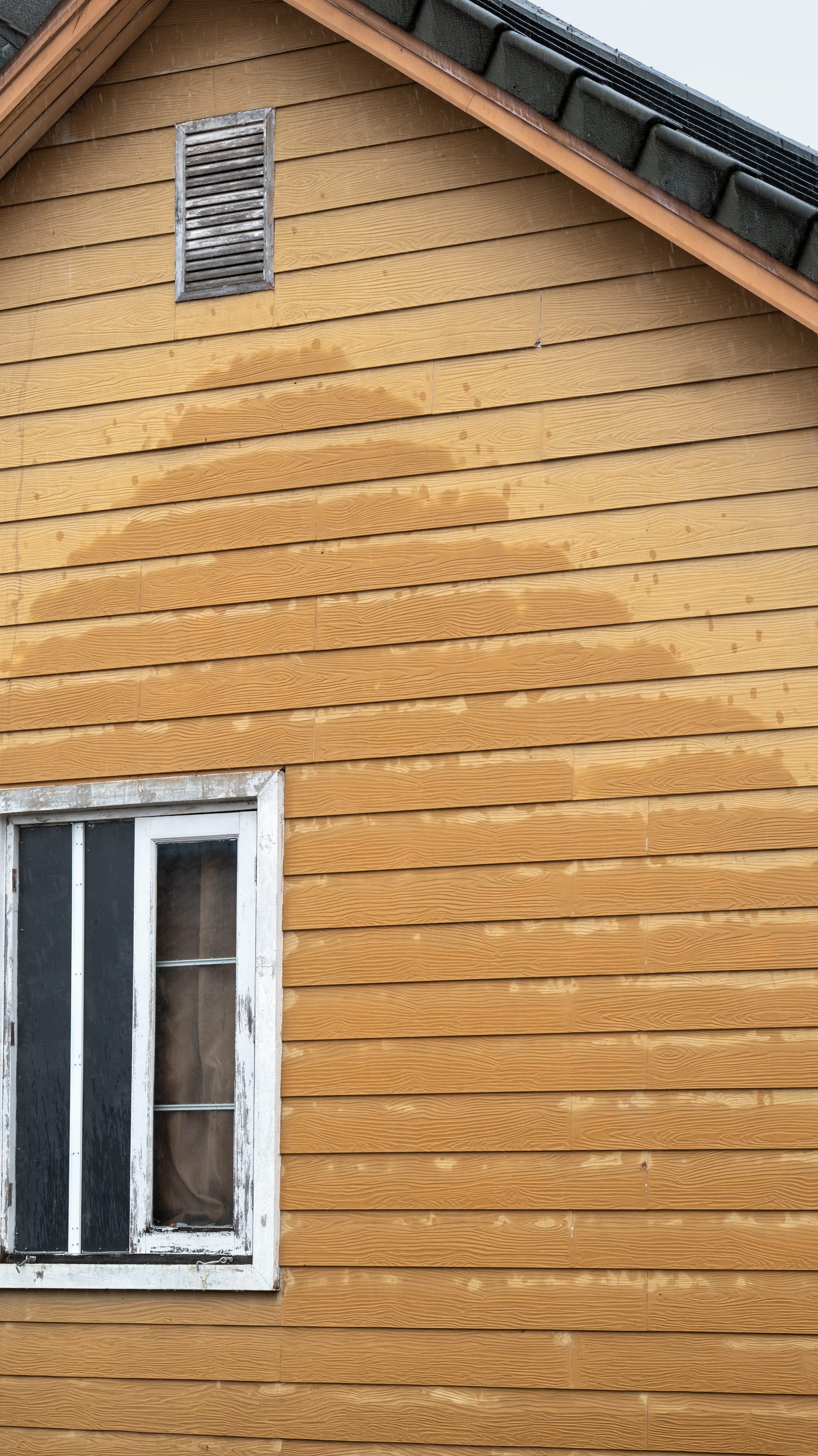
Lake Oswego's wet winters can accelerate visible paint problems when exterior coatings, caulk or wood are already compromised. Homeowners should watch for peeling, blistering, exposed wood, failed caulk, mildew, dark staining and soft trim, then correct active moisture sources before repainting damaged surfaces.
What Happens When Moisture Gets Behind Exterior Paint?
Moisture can disrupt adhesion.
Wood can absorb water and swell.
The coating film may begin loosening from the surface.
Eventually homeowners may see:
- Peeling
- Blisters
- Cracks
- Flaking
Sherwin-Williams describes moisture-related exterior peeling as loss of adhesion that can occur when a wet substrate swells and places stress on the paint film.
That is why repeated peeling should be investigated.
If the same trim board has been repainted three times and keeps peeling in the same place, the most interesting question probably isn't:
Which paint should we try next?
It's:
Why does this board keep getting wet?
What Does Paint Blistering Look Like?
Blistering usually appears as bubbles or raised sections in the coating.
They can vary from small areas to obvious bubbles.
Moisture is one possible cause.
Sherwin-Williams identifies moisture migration, damp substrates and exposure of fresh coatings to moisture as possible contributors to exterior blistering.
But not every bubble has the same cause.
Heat and application conditions can also create blistering.
That is why a visual symptom should begin the investigation.
Not finish it.
Why Is Trim Often the First Place Homeowners Notice Problems?
Trim contains lots of vulnerable geometry.
Think about:
- Window casings
- Fascia
- Door trim
- Horizontal surfaces
- Joints
- Corners
- End grain
Water doesn't always hit these surfaces and immediately leave.
It can:
- Run across them
- Sit against them
- Enter failed joints
- Reach exposed wood
Trim also has more edges than a broad wall of siding.
More edges mean more places where the coating system can weaken.
That is why Lake Oswego exterior maintenance should include more than standing in the street and looking at the main body color.
Walk closer.
The trim usually has more to say.
Why Does Fascia Paint Peel?
Fascia sits in one of the more interesting places on the house.
Right near:
- Roof edges
- Gutters
- Rainwater
If paint failure is concentrated along fascia, look beyond the paint.
Possible questions include:
- Is the gutter overflowing?
- Is water running behind it?
- Is there a roof-edge problem?
- Is the wood already deteriorated?
A fresh coat of paint can protect sound fascia.
It cannot convince an overflowing gutter to reconsider its career choices.
Fix active moisture sources first.
How Do Gutters Affect Exterior Paint?
A lot more than homeowners sometimes expect.
Gutters and downspouts are supposed to move water away from the building.
When they:
- Clog
- Overflow
- Leak
- Separate
water can repeatedly hit painted trim and siding.
Sherwin-Williams specifically identifies clogged or malfunctioning gutters as one possible source of moisture-related exterior paint failure.
If you notice exterior failure concentrated near gutters or downspouts, check the water path.
Do not make the painter your first call simply because paint is the visible casualty.
What About Roof Leaks?
Same principle.Exterior paint is not roof repair.
Water from a roof problem can reach:
- Fascia
- Soffits
- Trim
- Wall assemblies
If the moisture source continues, repainting the damaged surface may only reset the clock on the failure.
The leak needs attention first.
Then damaged material can be evaluated.
Then paint can return to doing the job it was designed for.
Why Does Failed Caulk Matter During Wet Winters?
Caulk can help protect selected joints and transitions from water intrusion.
Around appropriate areas such as:
- Windows
- Doors
- Trim joints
failed caulk may create an opening for water.
But more caulk is not always better.
Sherwin-Williams' exterior wood guidance specifically notes that while appropriate joints may benefit from caulking, sealing siding overlaps indiscriminately can trap moisture where the assembly needs to drain or breathe.
This is important.
The strategy is not:
Find every gap and fill it until the house is hermetically sealed.
The strategy is:
Seal the joints that are supposed to be sealed.
Why Do Shaded Lake Oswego Homes Need Extra Attention?
Shade slows drying.
Many Lake Oswego properties have:
- Mature trees
- Dense landscaping
- Hillside exposure
- Heavily shaded elevations
That can leave some exterior surfaces damp longer after rain.
Shade can also create conditions favorable to:
- Moss
- Mildew
- Organic growth
One elevation may therefore show problems years before another.
Lightmen's painting inspection guide specifically notes that one side of a Portland-area house can deteriorate much earlier than another because exposure conditions differ.
This is why exterior maintenance should happen elevation by elevation.
A house does not always age evenly.
Does Moss Damage Exterior Paint?
Moss itself is usually more of a symptom and maintenance issue than a diagnosis.
But if an area stays wet enough to support moss or persistent organic growth, pay attention to:
- Drainage
- Shade
- Surface condition
Organic material should not simply be painted over.
The surface should be appropriately cleaned and allowed to dry before coating.
Painting moss a fashionable new color would technically change its appearance.
That is about the nicest thing I can say about that strategy.
What About Mildew?
Mildew and dark staining are common concerns in damp, shaded environments.
Exterior surfaces should be cleaned appropriately before repainting.
Lightmen's exterior painting service includes evaluating mildew, dirt and chalky residue because contaminants can interfere with adhesion if they're simply painted over.
Recurring mildew may also tell you something about the location:
- Heavy shade
- Vegetation
- Limited airflow
- Persistent dampness
Cleaning solves the immediate surface condition.
Understanding why that side stays damp helps with future maintenance.
Can Winter Rain Make Small Cracks Worse?
It can expose weaknesses.
A small crack in a coating or joint may allow repeated moisture entry.
Then winter provides plenty of opportunities for that condition to repeat.
The important question is what is cracking.
Paint film?
Caulk?
Wood?
A structural joint?
Those require different responses.
Do not turn every crack into a paint defect.
Sometimes the painter is the right trade.
Sometimes the painter should be the person telling you another repair needs to happen first.
What Does Soft Trim Mean?
Soft wood deserves attention.
If exterior trim feels:
- Spongy
- Soft
- Crumbly
painting is no longer the first issue.
The substrate may be deteriorated.
Paint does not rebuild damaged wood.
It makes damaged wood a different color.
Minor painting preparation and major wood repair are different scopes.
If deteriorated trim is found, determine the repair requirement before final coating.
Should You Paint Over Slightly Damaged Wood to Protect It Until Spring?
That depends on the condition, moisture and repair.There isn't one answer for every situation.Coating unstable or deteriorated wood may simply hide a repair problem.Coating wet wood can create adhesion problems.If the concern is localized exposed wood during the wet season, the useful next step is to have the condition evaluated and decide whether:
- Maintenance
- Repair
- Temporary protection
- Full repaint
makes sense.Lightmen's Exterior Condition Report is intended for exactly that kind of question.
Does Winter Mean Exterior Painting Should Never Happen?
Most complete exterior repaints are better suited to more dependable dry-season conditions.
Lightmen's guide to the best time to paint a house in Portland identifies late spring through early fall as the more dependable exterior season because winter brings frequent rain, high humidity, cooler surfaces and limited drying windows.
That does not mean every exterior task becomes impossible all winter.
It means application conditions need to be appropriate for:
- Surface
- Product
- Temperature
- Moisture
- Forecast
A winter inspection is very different from forcing a full-house repaint into a week where the siding barely gets dry.
Lake Oswego Has a Long Wet Season
This is worth putting into local context.
The City of Lake Oswego's erosion-control requirements define October 1 through May 31 as the wet-weather season for exposed-soil management. Again, that is not a house-painting regulation, but it is an unusually clear local acknowledgment that wet conditions are not a short December event here. apps.lakeoswego.city
Nearby Portland climate normals tell the same broader story.
The wettest stretch is concentrated in late fall and winter, with normal downtown precipitation around:
- November: 6.58 inches
- December: 7.35 inches
- January: 6.36 inches
- February: 4.74 inches National Weather Service
A Lake Oswego exterior spends months managing repeated moisture exposure.
That is why the condition of the protective coating matters.
What Should You Inspect During Winter?
You do not need to become a building inspector.
Walk around the house and look for visible changes.
Pay particular attention to:
- Peeling paint
- Blistering
- Bare wood
- Failed caulk
- Dark staining
- Mildew
- Moss
- Soft trim
- Fascia damage
- Siding near gutters
- Window trim
- Door trim
Look at different elevations.
Especially:
- Heavily shaded sides
- Areas under trees
- Walls receiving roof runoff
- Lower siding near vegetation
Your objective is not to diagnose everything.
It's to notice which areas deserve another look.
Why Is Winter a Good Time to Find Paint Problems?
Because moisture makes patterns easier to see.
During the dry season, a small failure may appear minor.
During repeated rainfall, you may notice:
- The same board staying dark
- Water staining under one window
- Peeling along one roof edge
- Persistent mildew on one elevation
Those patterns can tell you where to investigate.
Winter is often poor for major exterior production.
It can be excellent for learning what the exterior needs.
Should You Wait Until Spring to Inspect?
No reason to.If something is actively deteriorating, knowing earlier gives you more choices.
Maybe it can wait.
Maybe a gutter needs repair.
Maybe exposed trim should be addressed.
Maybe you simply document it and schedule a spring repaint.
The point of inspection is not to create panic.It's to prevent:
I had no idea it was doing that
from becoming the spring project plan.
Is Fading the Same as Paint Failure?
No.
Fading is mainly a color and appearance change.
Failure usually involves loss of coating integrity.
Examples include:
- Peeling
- Blistering
- Cracking
- Exposed substrate
A faded house may still have a protective coating.
A beautifully colored house with peeling trim may have a more urgent maintenance problem.
Curb appeal matters.
Protection comes first.
Is Chalking Paint Failure?
Chalking is the powdery residue that some coatings develop as they weather.
A little weathering does not automatically mean emergency repainting.
Heavy chalking can indicate the coating is aging and requires proper cleaning and evaluation before repainting.
The important thing is not to apply new paint directly over an unstable chalky surface.
Paint likes suitable substrates.
Powder is not high on the list.
Why Do Window Casings Fail?
Windows are complicated exterior transitions.
They combine:
- Trim
- Seams
- Horizontal surfaces
- Drainage
- Repeated water exposure
If the coating is weakening around windows, inspect:
- Caulk
- Trim condition
- Sill areas
- Drainage
If staining appears repeatedly, determine where the water is coming from.
A painter can address appropriate coating and sealant problems.
Persistent building-envelope problems may require another trade.
Why Do Bottom Edges of Trim Matter?
Water follows gravity.
Horizontal surfaces and lower edges can receive concentrated exposure.
End grain can also absorb moisture differently from broad painted faces.
When inspecting painted wood, do not look only at what faces you from the yard.
Look at:
- Edges
- Corners
- Bottoms
- Joints
Those smaller areas can reveal deterioration earlier than the main face.
Does Good Exterior Paint Prevent Wood Rot?
Paint helps protect wood from exposure.
It does not create immunity from rot.
Wood can still deteriorate if moisture repeatedly reaches it through:
- Failed coatings
- Building leaks
- Poor drainage
- Failed joints
The useful system is:
Sound wood + controlled moisture + proper preparation + appropriate coating + maintenance
Remove one of those pieces and the others have to work harder.
Can Premium Paint Fix a Moisture Problem?
No.
Premium coatings can provide excellent exterior performance when correctly specified and applied.
They cannot fix:
- Leaking roof
- Overflowing gutter
- Rotten trim
- Persistent interior moisture migration
Sherwin-Williams lists moisture and environmental conditions alongside poor preparation and incorrect product use among common contributors to premature coating failure.
The better paint is still paint.
Do not ask it to become a drainage contractor.
Should Bare Wood Be Primed?
Generally, appropriate bare wood should receive the primer/coating system required for that material before finish paint.
Lightmen's exterior painting process includes spot priming exposed wood where appropriate.
Cedar may also require specific stain-blocking considerations because of tannins.
The exact system should follow:
- Wood type
- Condition
- Existing coating
- Finish product
Primer should solve a known problem.
Not simply appear because the estimate needed another line item.
Why Is Painting Wet Wood a Bad Idea?
Because excess substrate moisture can interfere with adhesion.
Sherwin-Williams' exterior guidance explicitly says wood and masonry can retain moisture after heavy rain and that wet surfaces need to dry before painting.
That becomes particularly important after a Lake Oswego winter.
A dry afternoon in early spring does not necessarily mean every piece of wood siding is ready for coating.
Shaded and exposed areas may need more drying time.
How Do You Know When Wood Is Dry Enough?
Professional evaluation can involve more than touching it.
Wood moisture can be checked with appropriate measuring tools where conditions warrant it.
Sherwin-Williams notes that treated wood is generally considered paintable after moisture content falls to an appropriate level, often around 15% or below for the situations described in its guidance.
That number should not be treated as one universal specification for every wood, coating and manufacturer.
The coating's actual requirements should control.
The broader principle is simple:
Dry the substrate before coating it.
Should You Wash Wood Siding After Winter?
Often, exterior surfaces need cleaning before repainting.
Winter can leave behind:
- Dirt
- Organic growth
- Mildew
- Pollution
- Debris
The correct cleaning method depends on the siding and condition.
Pressure should not automatically be maximized.
The objective is:
Clean surface
not:
Demonstrate the machine's horsepower.
Cleaning also adds water, which means the siding needs an appropriate drying period afterward.
What Happens if You Just Paint Over Peeling Areas?
The new coating inherits the unstable surface underneath it.
Loose paint needs to be removed to an appropriate sound edge.
Then the substrate can be:
- Evaluated
- Sanded as needed
- Primed where appropriate
- Recoated
Painting over loose paint is similar to installing a new roof over shingles that are actively falling into the yard.
The new material is only attached as well as the layer underneath it.
Does Every Peeling House Need a Full Repaint?
No.
This is where condition matters.
A home may have:
- One failed trim board
- One problematic elevation
- Localized bare wood
while most of the coating remains healthy.
Possible responses include:
- Maintenance
- Localized repair
- Phased work
- Full repaint
Lightmen's painting pricing and maintenance guide discusses this condition-first approach.
There is no award for repainting 4,000 square feet because twelve square feet need attention.
There is also no award for ignoring twelve square feet until they become four hundred.
When Does Localized Failure Become a Repaint?
Look at the pattern.
A complete repaint becomes more logical when:
- Peeling is widespread
- Many trim areas are failing
- The coating is heavily weathered
- Bare substrate appears across elevations
- Previous touch-ups are everywhere
- Color/finish degradation is broad
If the failure is isolated, maintenance may be more appropriate.
This is one reason an Exterior Condition Report can be useful before automatically pricing the entire house.
Understand the condition first.
Then decide how much work it deserves.
Should Lake Oswego Homeowners Inspect Gutters Before Repainting?
Yes.Especially if paint failure appears near:
- Fascia
- Soffits
- Roof edges
A painter does not need to become your gutter contractor.
But active water-management problems should be corrected before the final coating system is expected to perform.
You want the paint protecting the wood.Not fighting a recurring waterfall.
What About Landscaping Against Wood Siding?
Pay attention.Dense vegetation can limit airflow and keep surfaces damp longer.Landscaping can also make:
- Cleaning harder
- Inspection harder
- Painting access harder
You do not necessarily need to remove every plant near the house.
But branches and vegetation repeatedly contacting painted wood can create ongoing maintenance challenges.
Give the house some room to dry.
Does Lakefront or Heavily Wooded Exposure Change Maintenance?
It can.
Properties near significant vegetation or moisture-heavy environments may experience different:
- Shade
- Airflow
- Organic growth
- Drying patterns
That does not mean every lake-adjacent or wooded Lake Oswego home automatically needs more frequent painting.
It means the maintenance cycle should follow the actual property.
Exterior repaint intervals should not be treated like oil-change stickers.
Inspect the coating.
Does Winter Rain Shorten the Life of Exterior Paint?
Moisture exposure is one of several factors affecting coating life.
Others include:
- Prep quality
- Product
- UV
- Siding material
- Shade
- Maintenance
- Previous coatings
A good exterior coating system is intended to survive rain.
But repeated wetting can expose weaknesses faster when:
- Prep was poor
- Caulk failed
- Bare wood was left
- Moisture problems exist
The better question is:Is the current coating still doing its job?
How Often Should Lake Oswego Exterior Paint Be Inspected?
A quick visual check once or twice a year is useful.
You do not need a clipboard and hard hat.
Walk the exterior.
Pay extra attention:
After the wet season
because damage may be easier to identify.
Before the wet season
because you still have time to plan maintenance.
Look at the areas you know have historically been problematic.
Houses tend to develop personalities.
Unfortunately, some of those personalities involve fascia.
What Should You Check in Spring?
Spring is a good time to look for what winter revealed.
Check:
- Peeling
- Bare wood
- Soft trim
- Failed sealant
- Organic growth
- Water stains
- Gutter-related damage
Then classify the project:
Healthy
No immediate action.
Maintenance
Localized attention.
Repair
Substrate or moisture problem needs correction.
Repaint
Coating system is broadly reaching the end of its useful condition.
This is far more useful than assuming every older paint job automatically needs replacement.
IN OUR EXPERIENCE
Winter is when an exterior stops being polite about its problems.
Summer can make almost everything look pretty dry.
Then the rain starts.
One fascia board keeps getting darker.
One shaded wall stays damp.
A little trim spot starts peeling.
The same caulk joint opens again.
Those patterns are useful.
I would rather see them, figure out why they're happening and build the next repair or repaint around the cause than cover them with another coat and hope everyone forgets.
Paint can protect a house extremely well.
But only when we let it be paint.
Not roofing, drainage, carpentry and waterproofing all at the same time.
When Is the Best Time to Repaint a Lake Oswego Exterior?
Generally, use the more dependable dry-season windows when:
- Surfaces can dry properly
- Cleaning can dry
- Prep can proceed consistently
- Coatings have suitable application conditions
That is why planning the spring or summer exterior project during winter can actually be smart.
You can:
- Inspect
- Budget
- Decide colors
- Address repairs
- Get on the schedule
Then production can begin when weather and surfaces cooperate.
Waiting until the first 80-degree day to remember the house needs paint is also a strategy.
A popular one.
Can Exterior Maintenance Extend the Time Before a Full Repaint?
Sometimes.
If the coating system is generally healthy, catching small issues may help protect the house longer.
Maintenance might include addressing appropriate:
- Localized peeling
- Bare wood
- Failed caulk
- Trim trouble
But maintenance has limits.
It cannot meaningfully preserve a coating that has already failed across the entire exterior.
Lightmen's ongoing-care approach through LCC is built around monitoring and maintaining qualifying coatings rather than waiting for visible failure to become widespread.
Maintenance works best before the coating resigns.
How Can You Tell Paint Failure From a Moisture Problem?
Sometimes you cannot from the sidewalk.
Look for patterns.
Paint-age problems may be widespread.
Moisture problems may cluster around:
- Gutters
- Windows
- Roof edges
- One shaded elevation
- Lower siding
But those are clues.
Not proof.
If peeling keeps recurring, use Lightmen's paint-failure resources to start separating:
- Coating age
- Prep failure
- Moisture
- Substrate condition
- Product mismatch
Repeatedly repainting the same failure without understanding it is not maintenance.
It is tradition.
Should You Worry About One Small Peeling Spot?
You should notice it.
You do not necessarily need to panic.
A small spot can simply mean:
- Local damage
- Old repair
- Minor adhesion loss
But exposed substrate is worth watching.
Document it.
Check it after more wet weather.
If it expands, investigate.
Exterior maintenance works much better when homeowners notice small changes rather than waiting for paint to begin leaving the building in groups.
When Should You Call a Painter During Winter?
Call when you are seeing:
- Expanding peeling
- Bare wood
- Failed trim coatings
- Recurring blistering
- Dark staining
- Widespread caulk failure
- Unclear surface condition
You may not be scheduling immediate full exterior production.
You may be figuring out:
What needs to happen next?
That is still valuable.
What Should Lake Oswego Homeowners Expect From Lightmen Painting?
Lightmen Painting serves Lake Oswego homeowners as part of our Portland Metro service area, and our existing Lake Oswego house-painter guide is the closest currently indexed Lightmen page focused specifically on local Lake Oswego painting.
Our broader professional exterior painting service is built around the conditions western Oregon homes actually face:
- Rain
- Damp siding
- Shade
- Moss
- Mildew
- Failed caulk
- Peeling coatings
- Exposed wood
The goal is not to sell every Lake Oswego homeowner a full repaint every time a trim board peels.
The goal is to determine what is happening.
Sometimes the answer is:
Maintenance.
Sometimes:
Repair the water source.
Sometimes:
Replace damaged wood.
And sometimes:
The coating system has reached the point where repainting makes sense.
If winter has revealed peeling, exposed wood or questionable trim, start with the condition rather than picking colors.
Use Winter to Find the Weak Spots Before the Next Exterior Season
Walk your Lake Oswego exterior and look for:
- Peeling paint
- Bare wood
- Blisters
- Failed caulk
- Dark staining
- Soft trim
- Fascia problems
- Gutter-related damage
- Mildew
- Shaded siding that stays wet
Then ask the more useful question:
Why is this happening?
If the answer is a gutter, roof or substrate problem, fix that first.
If the coating is healthy except for a few areas, maintenance may be enough.
If failure is widespread, start planning the larger repaint.
Do You Have Questions? Give Us A Call!
If you’re in the Portland, OR metro area and you want:
a clean plan before repainting, or
help diagnosing exterior paint failures, or
a crew that resolves issues like adults or
You Just Have Questions…
Here’s the easiest path:
Call: 503-389-5758
-
People Also Ask:
Does winter rain damage exterior paint?
Rain does not automatically damage properly applied exterior paint. Problems are more likely when moisture reaches a weak or damaged coating, enters through failed joints or remains in an underlying substrate.
Why does exterior paint peel more during wet weather?
Wet substrates can swell, and repeated moisture can weaken paint adhesion. Existing leaks, failed caulk, exposed wood and poor previous preparation can make the problem worse.
Is wood siding more vulnerable during Lake Oswego winters?
Wood siding can absorb and release moisture, so exposed or poorly protected areas deserve attention during prolonged wet periods. Sound coatings, drainage and maintenance help protect the substrate.
Why is paint peeling from my fascia?
Possible causes include coating age or preparation problems, but fascia failures can also be associated with overflowing gutters, roof-edge leaks and repeated moisture exposure.
Should cedar siding be painted differently?
Cedar can require additional attention because moisture and naturally occurring tannins can affect the finished coating. Appropriate prep and primer selection are important.
Can you paint exterior wood when it is wet?
No. Exterior wood should be allowed to dry to an appropriate level before coating, following the requirements of the selected primer and finish system.
Does peeling trim mean I need to repaint the whole house?
Not necessarily. Localized peeling may be appropriate for maintenance or repair if the rest of the coating remains sound. Widespread failure makes a complete repaint more likely.
When should Lake Oswego homeowners inspect exterior paint?
Before and after the wet season are useful times. Fall can reveal vulnerable areas before prolonged rain, while spring helps show what winter moisture exposed.
-
Definitions
- Exterior paint: A protective and decorative coating formulated for outside surfaces.
- Wood siding: Exterior wall cladding made from wood, including cedar and other species.
- Cedar siding: Wood siding commonly used in Pacific Northwest homes and known for natural tannins and moisture-related coating considerations.
- Exterior trim: Painted wood or other material around windows, doors, corners and architectural details.
- Fascia: The board along the roof edge, often located behind or adjacent to the gutter.
- Soffit: The underside of a roof overhang.
- Substrate: The underlying material receiving a coating.
- Surface moisture: Water present on or inside the substrate.
- Moisture intrusion: Water entering an area or building component where it can affect materials or coatings.
- Paint adhesion: The strength of the bond between a coating and the surface below it.
- Peeling paint: Loss of paint adhesion resulting in coating lifting or separating from the substrate.
- Blistering: Bubble-like lifting of a coating, which can be associated with moisture or other application conditions.
- Tannin staining: Brown, tan or yellow discoloration caused when natural compounds in some woods migrate through the coating.
- Bare wood: Wood no longer protected by an intact coating system.
- Chalking: Powdery residue that develops on some aging exterior coatings.
- Mildew: Fungal growth that can develop on damp exterior surfaces.
- Caulk: Flexible sealant used at appropriate exterior joints and transitions.
- Spot priming: Applying primer only to selected exposed, repaired or problematic areas.
- Coating system: The combination of surface preparation, primer and finish coatings used to protect a surface.
- Exterior Condition Report: Lightmen Painting's exterior assessment resource used to understand coating condition and maintenance or repaint priorities.
- Maintenance painting: Localized coating work performed to maintain otherwise serviceable painted surfaces.
Serving Portland Homeowners Since 2019
Lightmen Painting works with homeowners across the greater Portland metro area — from first-time consultations to full exterior repaints. Whether you need a second opinion on a contractor's quote, a diagnosis for peeling paint, or a crew that shows up on time and communicates clearly, we're the team Portland homeowners call.
We serve: Portland, Tigard, Lake Oswego, Tualatin, West Linn, Milwaukie, Sherwood, Happy Valley, Oregon City, Beaverton, Hillsboro, and Gresham.
Lake Oswego's wet winters can expose weaknesses in exterior paint, wood siding, cedar siding, fascia, trim and caulking. Repeated rain and prolonged damp conditions become especially important when paint is already peeling, wood is exposed, gutters overflow, joints fail or shaded elevations dry slowly. Moisture behind exterior paint can contribute to peeling and blistering, while wet cedar may also develop tannin staining. Lake Oswego homeowners should inspect siding, fascia, window trim, failed caulk, bare wood, mildew and recurring water stains during the wet season and determine whether the correct next step is maintenance, repair, moisture correction or a full exterior repaint.