Multifamily & Apartments | Repaint Planning & Asset Protection | Real Estate Professionals

Revamping Your Office Space: Colors that Boost Productivity

Revamping Your Office Space: Colors that Boost Productivity

Delve into the vibrant world of office colors with Lightmen Painting! Discover how strategic color choices can significantly affect mood, creativity, and productivity. We'll guide you through the best hues for each office function and share expert tips for implementing an effective color scheme that transforms any workspace.

Key Highlights

  • The psychological impact of colors on mood and productivity.
  • Best color choices for different office functions.
  • Practical tips for implementing effective office color schemes.
  • Lightmen Painting’s personalized approach to office painting projects.


Colors that Boost Productivity

Understanding the Psychology of Colors in the Workplace

Choosing the right colors for your office space can significantly influence employee productivity and morale. We've seen firsthand how a well-thought-out color scheme can transform a dull workspace into an inspiring environment. Let’s dive into how different colors affect mood and productivity, and how you can strategically use them in various parts of your office.

The Impact of Color on Mood and Productivity

Colors have a profound impact on our emotions and behavior. Understanding this psychology can help you create a workspace that enhances productivity and fosters a positive atmosphere.

Blue for Calm and Focus: Blue is known for its calming effects. It helps reduce stress and anxiety, making it an excellent choice for areas where employees need to focus and concentrate. Think of spaces like private offices or study rooms. I once worked on an office project where we painted the main work area in a soft blue shade, and the client reported a noticeable increase in focus and calmness among the employees.

Yellow for Creativity and Energy: Yellow is a vibrant color that stimulates creativity and energy. It’s perfect for brainstorming rooms or creative departments. A splash of yellow can invigorate the space, making it a dynamic environment that encourages innovative thinking.

Red for Energy and Passion: Red is a powerful color that can evoke strong emotions and increase heart rates. It’s great for areas where a high level of activity and energy is desired, such as sales floors or fitness centers. However, use it sparingly as too much red can be overwhelming.

Green for Balance and Innovation: Green is associated with nature and tranquility. It promotes balance and harmony, making it an ideal color for meeting rooms where collaboration and innovation are key. In a project we completed for a tech startup, green meeting rooms became the favorite spots for team brainstorming sessions.

Choosing Colors Based on Office Function

Different areas of your office can benefit from specific color schemes tailored to their function.

Reception and Waiting Areas

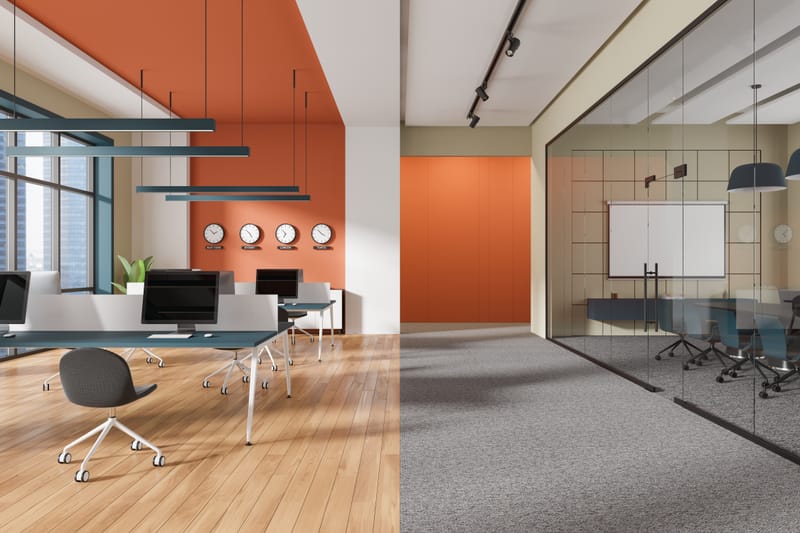
The reception area is the first impression visitors get of your business. Soft, welcoming colors like light blues or greens can make a positive impact. Adding a feature wall in a bold color like orange can also create a focal point and make the space more inviting.

Workstations

For individual workstations, colors that promote concentration and calmness are ideal. Shades of blue or green can help employees stay focused and reduce stress levels. Incorporating accent colors through furniture or décor can add visual interest without being distracting.

Meeting Rooms

Meeting rooms are spaces for collaboration and decision-making. Green is an excellent choice here as it fosters innovation and calm discussions. Another effective strategy is to use neutral colors like beige or grey and add bright accents through artwork or furniture to create a balanced yet stimulating environment.


Best Colors for Office Productivity

Blue – The Focus Enhancer

Blue is known for its calming properties, which can significantly enhance focus and reduce stress levels. This makes it an ideal choice for environments where concentration is key. Picture a finance office, where employees need to focus on intricate details and numbers for extended periods. Painting the walls in shades of blue can help create a serene environment that minimizes anxiety and distractions.

I once worked on a project where we transformed a finance office with a calming blue palette. The change was remarkable. Employees reported feeling more focused and less stressed, which positively impacted their productivity and overall job satisfaction. The subtle, cool tones of blue provided the perfect backdrop for intense concentration without being overwhelming.

Green – The Balancer

Green is another fantastic color for office spaces, particularly because it promotes a sense of balance and calm. It’s also known to reduce eye strain, which is crucial for employees who spend long hours at their desks. Incorporating green into your office design can help create a refreshing atmosphere that feels both natural and tranquil.

Imagine a tech company where developers and designers spend most of their day in front of screens. By adding green elements—whether it’s through wall paint, plants, or décor—you can create a soothing environment that mitigates the fatigue associated with prolonged screen time. In one of my projects, we used varying shades of green to redesign a client’s workspace, and the feedback was overwhelmingly positive. Employees felt more relaxed and refreshed, which translated to increased productivity and fewer complaints about eye strain.

Yellow – The Energizer

Yellow is a color that exudes energy and stimulates creativity. It’s perfect for areas where brainstorming and innovative thinking are encouraged, such as marketing departments or creative studios. Yellow can inspire enthusiasm and positivity, making it easier for teams to come up with fresh ideas and solutions.

In a marketing firm I collaborated with, we painted the brainstorming room in a bright, cheerful yellow. The transformation was immediate. The room became a hub of creativity, and team members felt more energized and excited to contribute their ideas. Yellow’s vibrant presence acted as a catalyst for innovative thinking, turning a previously dull space into a dynamic and inspiring environment.

Red – The Stimulator

Red is a powerful color that can evoke strong emotions and stimulate energy and excitement. It’s particularly effective in spaces where high levels of activity and motivation are needed, such as sales offices. Red can increase heart rate and create a sense of urgency, which can drive performance and enthusiasm.

However, it’s essential to use red strategically. Overdoing it can lead to feelings of aggression or anxiety. In a sales office I revamped, we used red accents sparingly—on trim, furniture, and feature walls—to inject energy without overwhelming the space. The result was a noticeable boost in the team’s drive and competitiveness, aligning perfectly with the high-energy demands of a sales environment.

Colors to Avoid in Office Spaces

Overly Dark or Intense Colors

While some bold colors can stimulate productivity, overly dark or intensely bright colors can have the opposite effect. Colors like black or neon shades can be distracting, overwhelming, and even depressing. They can create a heavy atmosphere that hampers focus and reduces morale.

Neutral Overload

While neutrals like beige, gray, and white can provide a clean, professional look, using them excessively can result in a bland and uninspiring environment. An overload of neutral tones can make an office feel sterile and devoid of energy, which can dampen creativity and motivation.

In another project, a client’s office was dominated by gray walls and furniture. Employees described the space as dull and uninspiring, which reflected in their lackluster performance. We introduced a more vibrant color scheme, incorporating blues, greens, and accent colors to invigorate the space. The transformation revitalized the office, boosting employee morale and fostering a more dynamic and engaging work environment.

We understand the profound impact that color can have on productivity and well-being. Our expertise in selecting the right colors for your office ensures that your workspace not only looks great but also supports your team’s performance and satisfaction. Whether you’re looking to enhance focus with calming blues or stimulate creativity with vibrant yellows, we’re here to help you create an environment that works for you.


In Our Experience:

"We've seen firsthand the dramatic transformation that the right colors can bring to an office environment. By applying specific shades like calming blues in high-focus areas and energizing yellows in creative spaces, our clients have reported enhanced mood, increased productivity, and overall greater satisfaction among employees. Our approach is always personalized, ensuring that each color scheme perfectly aligns with the unique dynamics and goals of the workplace."


Lightmen Painting’s Approach to Office Spaces

Expert Consultation

We pride ourselves on providing personalized advice tailored to maximize office productivity through strategic color selection. Our expert consultants understand that each business has unique needs and aesthetic goals, and we work closely with clients to create the ideal color palette for their workspace.

Personalized Advice

Our consultation process begins with a thorough assessment of your office space. We consider factors such as the nature of your business, the layout of the office, and the desired ambiance. For example, we recently helped a local marketing firm transform their office. They wanted a vibrant yet professional atmosphere that would stimulate creativity. By incorporating bold accent walls in their brainstorming areas and calming neutrals in their private offices, we created an environment that energized the team and enhanced productivity.

High-Quality Materials and Techniques

Using high-quality, durable materials is crucial for ensuring a long-lasting, healthy work environment. We use low-VOC (volatile organic compounds) paints that are eco-friendly and safe for indoor use. Low-VOC paints reduce the emission of harmful chemicals, promoting better indoor air quality, which is essential in maintaining a healthy workspace.

Commitment to Eco-Friendly Products

We are committed to sustainability and environmental responsibility. Our choice of eco-friendly products not only benefits our clients but also aligns with our goal of reducing our ecological footprint. In every project, we ensure that our materials and techniques meet the highest standards of quality and safety.

Tailored Solutions for Every Office

Every business is different, and so are their needs when it comes to office design. We tailor our painting services to fit the unique requirements of each client, ensuring that the final outcome reflects their branding and company culture.

Custom Color Schemes

Whether it’s matching your company’s branding colors or creating a specific ambiance to enhance productivity, we have the expertise to deliver custom solutions. For instance, we worked with a tech startup to design a color scheme that not only mirrored their innovative brand but also fostered a collaborative environment. By using a mix of modern grays and vibrant blues, we were able to create a space that felt both cutting-edge and inviting.

Practical Tips for Implementing Office Colors

Start with a Plan

Before diving into painting, it's crucial to have a well-thought-out plan. This involves selecting color palettes, testing samples, and considering the overall design vision.

Tips on Testing Colors

One effective way to visualize how colors will look in your space is to use sample boards or paint small test areas on your walls. This approach allows you to see how different shades interact with your office lighting and existing decor. For example, a client once thought they wanted a bright yellow feature wall, but after testing, they realized a softer shade of yellow worked better with their natural light and furniture.

Consider Natural Light

Natural light plays a significant role in how colors appear in a room. It's essential to test colors in different lighting conditions to ensure they look good throughout the day.

Impact of Natural Light

I remember working on an office that had large windows facing east. The colors looked vibrant and fresh in the morning but dull and washed out in the afternoon. By adjusting the color palette to include tones that worked well with both morning and afternoon light, we achieved a consistently appealing look.

Balance Bold and Neutral

Balancing bold colors with neutral tones can create a dynamic yet harmonious work environment. Bold colors are excellent for creating focal points and energizing spaces, while neutrals help maintain a calm and professional atmosphere.

Using Bold and Neutral Colors

One of our projects involved an advertising agency where we used bold colors like red and orange on feature walls to stimulate creativity and energy. The rest of the office was painted in soothing neutral tones, providing a balanced and professional look. This combination helped create a space that was both inspiring and conducive to focused work.

Choosing the right colors for your office can significantly impact productivity, creativity, and overall employee satisfaction. We combine expert consultation, high-quality materials, and tailored solutions to transform workspaces. Whether you're looking to invigorate your office with bold colors or create a serene environment with calming tones, we have the expertise to bring your vision to life.


Do You Have Questions? Give Us A Call With Any & All! 

If you’re in the Portland, OR metro area and you want:

a clean plan before repainting, or

help diagnosing exterior paint failures, or

a crew that resolves issues like adults or

You Just Have Questions…

Here’s the easiest path:

Request an estimate

Email: scheduling@lightmenpainting.com

Call: 503-389-5758

-

People Also Ask:

What are the best colors for increasing productivity in the office?

The best colors for increasing productivity vary depending on the type of work and the atmosphere you wish to create. Blue is excellent for tasks that require focus and mental strain, as it promotes calm and stable feelings. Yellow sparks creativity and is ideal for environments where innovation is key, while green offers a balanced and refreshing vibe to reduce eye strain.

How does the choice of office color affect employee mood and productivity?

Color significantly affects employees' moods and productivity. Certain colors can energize or calm the mind, influencing how individuals feel and perform. For example, red can increase energy levels and alertness, making it suitable for high-activity areas. Conversely, blue can help with concentration and stress relief, making it ideal for intense workspaces.

What are practical tips for implementing effective office color schemes?

When implementing color schemes, it's crucial to consider the psychological effects of color, the natural light available, and the specific tasks performed in each area. Test paint colors in different lights, use color psychology to match the desired emotional response, and balance bold colors with neutrals to avoid overwhelming spaces.


-

Subscribe to Our Blog & Elevate Your DIY Game! Never miss a beat! Join the Lightmen Painting community and get the latest insights on painting, DIY projects, and expert tips delivered straight to your inbox.

Have something specific in mind? We’d love to hear your ideas! Let us know what topics or projects you’re curious about—your input could shape our next post.


Transform Your Space — Or Just Look Like You Know What You're Doing.

Ready to upgrade your painting game? From pro-approved tools to field-tested templates, the Lightmen Shop has the stuff the pros don’t want you to find.

Click in, gear up, and paint smarter.

If your in the Portland, Or. area and need advice or a free no obligation estimate call us at 503-389-5758 or email scheduling@lightmenpainting.com


Resources: 


Definitions

  • Color Psychology: The study of how colors affect human behavior and mood, crucial for designing effective office spaces.
  • Productivity: The effectiveness of productive effort, especially in industry, as measured in terms of the rate of output per unit of input.
  • Mood: A temporary state of mind or feeling that colors can significantly influence.
  • Focus: The center of interest or activity; specific colors can enhance concentration and reduce distractions.
  • Creativity: The use of imagination or original ideas to create something; invigorated by stimulating colors like yellow.
  • Energize: To give vitality and enthusiasm to environments, often achieved with the use of vibrant colors like red.
  • Calm: A peaceful mental state that certain colors, such as blue and green, can help achieve.
  • Office Functions: Different activities performed in an office setting that may require varied color environments.
  • Visual Appeal: The aesthetic attractiveness of a space, enhanced by color schemes that complement the office’s design.
  • Behr Drywall Primer: A product mentioned for its importance in preparing office walls for painting, ensuring a smooth and even finish.


Trusted in Portland, Happy Valley, Sherwood, Lake Oswego, and Beaverton
Cabinets, interiors, exteriors, apartment complexes

See recent projects          Get an estimate
Read More  

7 No B.S. Steps to Grow Your Real Estate Business This Year

Let’s cut the fluff. If you’re a real estate agent trying to grow your business this year, chances are you’ve already been bombarded with vague advice like “just post on Instagram” or “send postcards.” Thanks, Karen. What you need are practical, proven, and profitable strategies that actually move the damn needle.

Key Features

  • Tactical real estate growth strategies tailored for 2026
  • Partnership-driven marketing with home service pros like Lightmen Painting
  • SEO and video-first tactics to capture and convert more leads


Let’s cut the fluff. If you’re a real estate agent trying to grow your business this year, chances are you’ve already been bombarded with vague advice like “just post on Instagram” or “send postcards.” Thanks, Karen. What you need are practical, proven, and profitable strategies that actually move the damn needle.

We work with top agents and watch how they grow in real time. We've also built our own business by ranking on Google and developing solid relationships—not gimmicks. So, here are 7 no-B.S. steps to help you grow your real estate business this year, backed by results and actionable insights.


What Are the Most Effective Ways to Grow a Real Estate Business in 2026?

1. Build a Local SEO Powerhouse

Get on Google—and I don’t mean just showing up. I mean dominating local search results for terms like “Portland home listings”, “realtors near me”, or “top real estate agents in [your area].”

Checklist:

  • Claim and optimize your Google Business Profile
  • Get more 5-star reviews (ask happy clients immediately)
  • Build local backlinks from community sites and service providers (like us!)
  • Create location-specific blog posts (e.g., “Best neighborhoods to buy in Tigard, OR”)

Local SEO = 24/7 lead machine.


Things to Know

  • Google is still your #1 long-term marketing channel—optimize your presence.
  • Partnerships create momentum: collaborate with painters, roofers, landscapers, and more.
  • Personalized video and hyper-local content perform better than polished ads.
  • Agents with value-driven funnels outperform those who only promote listings.
  • Offering useful content before asking for the sale builds trust and gets referrals.

2. Partner With Trusted Home Service Pros

Smart agents know: you’re not just selling homes—you’re selling a whole experience. 

Team up with businesses like:

  • Painters (like Lightmen Painting)
  • Electricians
  • Stagers
  • Landscapers
  • Junk removal crews

Offer a “preferred vendor list” to clients and cross-promote each other. We’ve sent more than a few jobs back and forth with agents we trust—and we can tell you, it works.

3. Get Hyper-Local With Your Social Content

Forget generic “Happy Closing Day” posts. If you're not speaking to your exact neighborhood with real, raw, and useful content, you’re getting scrolled past.

Ideas that crush:

  • “5 Homes Under $500K in Sellwood Right Now”
  • “Here’s What $750K Gets You in Hillsdale”
  • “Avoid These Mistakes When Buying in Ladd’s Addition”

People want YOU to be the boots-on-the-ground expert.


In Our Experience

We’ve worked with real estate agents who double their business by simply offering better value and showing up online with intention. The ones who win? They treat every listing like a brand. They team up with trusted contractors. And they aren’t afraid to try bold marketing moves—especially video. You do that, and you’re already ahead of 90% of agents out there.


4. Offer Free Value Without Pitching

The biggest lead magnet? Actually helping people.

Create helpful, free digital assets like:

  • A first-time buyer’s guide (PDF)
  • “How to Prep Your Home for Sale” checklist
  • A neighborhood investment map with local school info

Use these to build your email list, follow up, and stay top of mind.

5. Create “Mini Funnels” For Every Property

Marketing a listing? Stop posting a Zillow link and calling it a day. 

Instead:

  1. Make a landing page just for that property (can be simple)
  2. Include photos, a short video, neighborhood info, and a contact form
  3. Drive traffic from social, email, or even Google Ads

Now you’ve got exclusive traffic and captured leads

—not Zillow’s.

6. Get on Video (Even if You Hate It)

Sorry, but video is the cheat code. You don’t have to be a polished anchor—just be your authentic self.

Here’s what works:

  • “This Week’s Hot Property Picks”
  • “Why This Home Is Worth $1.1M”
  • “I’m Standing In a Fixer With 3 Crazy Opportunities”

Shoot vertical on your phone. Upload to Instagram Reels, YouTube Shorts, and TikTok. Rinse, repeat.

7. Work With a Marketing-Driven Painting Company (Seriously)

Hear me out: Lightmen Painting isn't just a contractor—we’re content marketers. We offer weekly blogs, SEO boosts, and free content marketing for agents we partner with.

You give us a lead, and we return the favor with content that drives more traffic to your site, builds credibility, and helps you rank better on Google. No contracts. No gimmicks. Just local collaboration.


Do You Have Questions? Give Us A Call! 

If you’re in the Portland, OR metro area and you want:

a clean plan before repainting, or

help diagnosing exterior paint failures, or

a crew that resolves issues like adults or

You Just Have Questions…

Here’s the easiest path:

Request an estimate

Email: scheduling@lightmenpainting.com

Call: 503-389-5758

-

People Also Ask:

How can real estate agents get more leads online in 2026?

Focus on SEO, local content, and lead magnets. Partner with contractors and use video to drive engagement and conversions.

What kind of content should real estate agents post?

Neighborhood guides, home tours, “how-to” buyer/seller videos, market updates, and collaborations with local businesses.

Is it worth working with local service providers as a realtor?

Absolutely. Strategic partnerships with painters, stagers, and landscapers help your listings shine—and lead to referrals in both directions.


-

Subscribe to Our Blog & Elevate Your DIY Game! Never miss a beat! Join the Lightmen Painting community and get the latest insights on painting, DIY projects, and expert tips delivered straight to your inbox.

Have something specific in mind? We’d love to hear your ideas! Let us know what topics or projects you’re curious about—your input could shape our next post.


Transform Your Space — Or Just Look Like You Know What You're Doing.

Ready to upgrade your painting game? From pro-approved tools to field-tested templates, the Lightmen Shop has the stuff the pros don’t want you to find.

Click in, gear up, and paint smarter.

If your in the Portland, Or. area and need advice or a free no obligation estimate call us at 503-389-5758 or email scheduling@lightmenpainting.com


Want to Learn How to Paint Like a Pro?

Whether you're a DIY enthusiast or dreaming of starting your own painting business, we've got you covered! Lightmen Painting now offers exclusive online Painting Courses designed to teach you real-world skills from real professionals. From prep work to perfect brush technique, we break it all down step-by-step.

👉 Check out the courses here: Lightmen Courses 

Take the first step—level up your skills and paint with confidence. Let’s roll!


Resources: 


Definitions

  • Local SEO – Search engine optimization focused on ranking in your geographical area
  • Lead Funnel – A system that brings in leads and nurtures them through emails, ads, or follow-ups
  • Backlinks – Links from other websites that boost your Google ranking
  • Hyper-Local Content – Posts focused on a specific area, like a neighborhood or zip code
  • Vendor List – A curated group of service pros an agent recommends
  • Digital Asset – A downloadable guide, checklist, or resource offered for free
  • Call to Action (CTA) – A prompt telling your audience what to do next (e.g., “Schedule a showing”)
  • Landing Page – A web page focused on a single campaign or property
  • Video Marketing – Using short or long videos to promote properties or your brand
  • Cross-Promotion – Collaborating with another business to reach a shared audience


Trusted in Portland, Happy Valley, Sherwood, Lake Oswego, and Beaverton
Cabinets, interiors, exteriors, apartment complexes

See recent projects          Get an estimate

Read More  

Why Your Commercial Repaint Is More Complex Than You Think (And How to Plan for It)

Key Features

  • Breaks down why commercial repaint projects fail before they start
  • Explains real cost drivers (not just paint and labor)
  • Provides a practical planning framework for property managers


If you’ve ever looked at a commercial repaint and thought, “This should be pretty straightforward,” you’re not alone—and you’re also exactly who this article is for.

At a glance, repainting a commercial property feels simple: pick a color, pick a product, schedule the work, done. But in reality, most projects don’t fail because of paint—they fail because of planning.

This breakdown walks you through the real reasons commercial repaint projects go sideways, what most people miss early, and how to avoid turning a routine repaint into an expensive operational headache.


The Operational Mess vs. The Straightforward Project

For facility and property managers, a commercial repaint often presents as a deceptively simple maintenance task: select a color, choose a product, and find a window on the calendar. However, projects that seem technically straightforward frequently devolve into an "operational mess" that dismantles budgets and timelines.

The reality is that while the quality of the paint matters, the chemistry of the coating is rarely what causes a project to fail. The breakdown almost always occurs in the planning phase—or the lack thereof.

To bridge the gap between a vague estimate and a successful execution, we utilize the Commercial Repaint Planning Notebook. This tool is designed to move property professionals away from guesswork and toward a strategy that accounts for scope, phasing, and operational risk before a single drop of paint is purchased.

👉 Translation: The difference between a smooth project and a disaster is rarely the paint—it’s everything before the paint.


Things to Know

  • Most repaint failures are planning failures
  • Hidden prep is the #1 budget killer
  • Access issues can double labor time
  • Phasing reduces disruption and improves execution
  • “Convenient schedules” often cost more


The "Hidden Prep" Budget Trap

The most significant driver of cost overruns in commercial repainting is "hidden prep." These are the variables that remain invisible during a casual observation but dictate the actual labor hours required.

The primary reason these issues are missed in early assumptions is the "proximity factor." Most facility managers view their buildings from the ground or through an office window. However, substrate failure and coating degradation are often only visible within arm's reach.

What looks solid from thirty feet away can be falling apart up close.


Critical Hidden Factors (Where Budgets Get Wrecked)

  • Failed Sealant and Caulk
    → Usually needs full replacement, not touch-ups
  • Substrate Wear and Unstable Coatings
    → Requires removal, not repainting
  • Cleaning Requirements
    → Impacts labor, water control, and site logistics
  • Rust and Corrosion
    → Needs treatment systems, not coverage
  • Repeated Failure Zones
    → Indicates underlying moisture or structural issues

Reality Check

"A building may not need a full nightmare overhaul, but hidden prep still needs to be understood before pricing is taken seriously."

👉 If prep isn’t defined early, your “estimate” is just a guess with a deadline.


Access Is Not a "Side Detail" (It’s the Budget Driver)

In a commercial environment, access is a primary driver of the project’s financial math. If a crew cannot efficiently reach a surface, labor costs balloon, and sequencing breaks down.

Access is not a logistical detail—it is a cost center.

What Actually Impacts Cost (That People Ignore)

  • Equipment Staging
    → Idle lifts = paid time doing nothing
  • Daily Logistics
    → Moving equipment eats hours fast
  • Restricted Work Zones
    → Limited working windows = longer timelines
  • Pedestrian Flow
    → Safety planning affects everything

👉 Awkward access doesn’t just slow things down—it changes the entire job structure.


Why Phasing Beats the "Giant Block" Approach

The instinct to treat a repaint as one giant, uninterrupted block of work is often a mistake for active commercial properties.

It looks efficient on paper.It’s not.

Why Phasing Wins in the Real World

  • Targeted Tenant Coordination
    → Clear, short windows instead of vague disruption
  • Operational Continuity
    → Business keeps running
  • Managed Noise and Access
    → Controlled impact instead of chaos

In Our Experience

The projects that go smoothly aren’t the simplest—they’re the ones that are understood early. When scope, access, and phasing are clearly defined upfront, everything else becomes predictable. When they’re not, even a basic repaint turns into a moving target.


👉 A repaint project may be easier to execute when planned in phases instead of treated like one giant uninterrupted block of work.


The Reality of the "Convenient" Schedule

In the world of property planning, an unrealistic schedule is a financial liability.

The timeline you want rarely matches the timeline the building requires.

What a Real Schedule Has to Respect

  • Weather constraints (especially in the PNW)
  • Cure times and coating requirements
  • Interior traffic patterns
  • Ventilation and safety conditions
  • After-hours labor costs

👉 The most convenient schedule is rarely the most realistic one.

And unrealistic schedules are where projects start bleeding money.


Walkthrough First, Pricing Second

Requesting an immediate estimate for a complex property is often premature.

If you skip planning, you don’t save time—you just delay problems.

When You Need a Walkthrough

  • Early budgeting phase
  • Known problem areas
  • Complex access or occupancy conditions

When You Need an Estimate

  • Scope is clearly defined
  • Project is ready to move
  • Variables are already understood

👉 Pricing before planning = pricing drift later. Every time.


The Commercial Repaint Diagnostic Checklist

Use this before calling anyone:

  • ☐ Do we know the condition of coatings up close?
  • ☐ Have caulking and sealants been evaluated?
  • ☐ Are access challenges mapped out?
  • ☐ Do we have a realistic schedule?
  • ☐ Is phasing required?
  • ☐ Are there known failure zones?

If you answer “no” to multiple:

👉 You’re not ready for pricing yet—you’re still in planning.

If your repaint still feels “simple,” that’s usually the first warning sign.The smartest move is getting clarity before committing to scope, schedule, or pricing.If you want a walkthrough that actually breaks down risk, access, and real cost drivers—not just a number—Lightmen Painting can help you map it out the right way.


Do You Have Questions? Give Us A Call! 

If you’re in the Portland, OR metro area and you want:

a clean plan before repainting, or

help diagnosing exterior paint failures, or

a crew that resolves issues like adults or

You Just Have Questions…

Here’s the easiest path:

Request an estimate

Email: scheduling@lightmenpainting.com

Call: 503-389-5758


-

People Also Ask:

Why do commercial painting projects go over budget?

Most overruns come from hidden prep, access challenges, and poor early planning—not material costs.

What is the most important step before a commercial repaint?

A detailed walkthrough to identify prep, access, and scheduling variables before pricing.

Should commercial painting be done in phases?

Yes. Phasing reduces disruption, improves efficiency, and allows better coordination with occupants.


-

Subscribe to Our Blog & Elevate Your DIY Game! Never miss a beat! Join the Lightmen Painting community and get the latest insights on painting, DIY projects, and expert tips delivered straight to your inbox.

Have something specific in mind? We’d love to hear your ideas! Let us know what topics or projects you’re curious about—your input could shape our next post.


Transform Your Space — Or Just Look Like You Know What You're Doing.

Ready to upgrade your painting game? From pro-approved tools to field-tested templates, the Lightmen Shop has the stuff the pros don’t want you to find.

Click in, gear up, and paint smarter.

If your in the Portland, Or. area and need advice or a free no obligation estimate call us at 503-389-5758 or email scheduling@lightmenpainting.com


Want to Learn How to Paint Like a Pro?

Whether you're a DIY enthusiast or dreaming of starting your own painting business, we've got you covered! Lightmen Painting now offers exclusive online Painting Courses designed to teach you real-world skills from real professionals. From prep work to perfect brush technique, we break it all down step-by-step.

👉 Check out the courses here: Lightmen Courses 

Take the first step—level up your skills and paint with confidence. Let’s roll!


Resources: 


Definitions

  • Commercial repaint – Repainting of commercial buildings
  • Surface prep – Cleaning, repairing, and preparing surfaces before painting
  • Coating system – Layers of primer and paint used for protection
  • Caulk failure – Breakdown of sealant allowing water intrusion
  • Phasing – Completing work in sections instead of all at once
  • Access logistics – Equipment and movement planning for job execution
  • Substrate – The surface being painted
  • Operational disruption – Impact on tenants or business operations
  • Repaint planning – Strategy for timing, scope, and execution
  • Facility maintenance painting – Painting tied to long-term property upkeep


Trusted in Portland, Happy Valley, Sherwood, Lake Oswego, and Beaverton
Cabinets, interiors, exteriors, apartment complexes

See recent projects          Get an estimate

Commercial repainting projects in Portland require detailed planning due to moisture exposure, building use, and operational constraints. Commercial painting Portland projects often involve hidden prep, access challenges, and scheduling limitations that impact cost and execution. Property managers and facility managers must account for surface preparation, coating failure, caulking, phasing, and tenant coordination when planning a commercial repaint. Proper walkthroughs, accurate scoping, and strategic planning are essential to avoid cost overruns and project delays. Portland commercial painters must evaluate weather conditions, building access, and operational disruption to deliver a successful repaint project.

Read More  

Commercial Real Estate Painting Portland: Repaint Planning for Brokers, Owners & Asset Managers

If you work in commercial real estate in Portland, paint is not just cosmetic. It affects leasing velocity, tenant perception, maintenance optics, budgeting, access planning, and how much trouble a tired building quietly creates before anyone wants to deal with it.

KEY FEATURES

  • Built for real CRE roles-This page speaks directly to brokers, owners, and asset managers instead of writing to some imaginary generic “commercial customer.”
  • Anchors the full cluster-It sits above the exterior, interior, office/retail, warehouse, and paint-failure sub-pillars.
  • Decision-first structure-The article frames repainting around asset goals, not vague paint enthusiasm or random maintenance guilt.


Commercial real estate people usually do not call a painter because they are bored.

They call because something is happening.

A broker needs a space to show better. An owner needs to reduce the “this building feels tired” problem before it starts dragging on leasing. An asset manager is trying to plan a repaint without turning access, operations, or budget into a mess. A property team is staring at visible wear, deferred maintenance, or paint failure and trying to decide whether the smart move is a full repaint, selective work, phased work, or a diagnostic pass before anyone starts throwing numbers around.


THINGS TO KNOW

  • Commercial repaint planning makes more sense when it follows the property goal first.
  • Portland weather compresses exterior timing and punishes late planning. 
  • Lower commercial bids often hide weaker scope logic.
  • Paint failure, leasing support, common-area refreshes, and occupied-space work should not be treated like the same category.
  • A cleaner scope usually produces a better ROI than a bigger scope.


That is where commercial real estate painting in Portland becomes its own category. This is not the same as a homeowner repaint. It is not just “freshen the walls and move on.” The decision sits inside a bigger stack of realities:

  • leasing
  • tours
  • tenant disruption
  • weather windows
  • scope control
  • maintenance planning
  • repositioning timing
  • risk reduction

And Portland adds its own layer to that. The National Weather Service says nearly 90 percent of Portland’s annual rainfall falls between mid-October and mid-May, with summer providing the driest stretch for exterior work. That makes repaint timing, sequencing, and maintenance planning a lot less forgiving when owners wait too long or try to jam exterior work into the wrong window. (Lightmen Painting)

This page is the master pillar for the CRE cluster. 

It is built for:

  • brokers
  • commercial property owners
  • asset managers
  • small portfolio operators
  • mixed-use decision-makers
  • office and warehouse stakeholders

From here, the cluster branches into the more specific pages:

What does commercial real estate painting actually mean in Portland?

It means paint work tied to property performance, not just appearance.For CRE professionals, painting usually sits inside one of these categories:

  • leasing support
  • tenant improvement support
  • repositioning
  • maintenance correction
  • failure response
  • common-area refresh
  • exterior curb-appeal reset
  • occupancy-sensitive interior work
  • phased portfolio maintenance

That is important because the same building can need totally different paint strategies depending on what the asset is trying to do next.

A broker preparing a suite for tours does not need the same scope as an owner stabilizing a multi-tenant exterior. A warehouse operator trying to repaint around active traffic does not need the same plan as a mixed-use office building trying to tighten up common areas before renewals.

That is why this cluster exists. The wrong commercial paint scope is not just wasteful. It can also slow leasing, frustrate tenants, create access issues, and make budgets look worse than they needed to.

Why do brokers, owners, and asset managers care about paint at different times?

Because they feel the pain differently.

Brokers care when paint affects leasing

If a property shows tired, dirty, chipped, faded, or neglected in the wrong places, it starts hurting:

  • tours
  • listing photos
  • first impressions
  • confidence in building management
  • how “ready” the space feels

That is why a broker-specific support page belongs in this cluster: How CRE Brokers Can Use Paint to Lease Portland Space Faster.

Owners care when paint affects value and maintenance

Owners usually feel it when:

  • visible wear starts stacking up
  • deferred maintenance becomes harder to ignore
  • competitive properties look sharper
  • buyers or tenants start noticing the roughness
  • the cost of waiting starts rising

Asset managers care when paint affects planning and control

Asset managers usually are asking:

  • what actually needs to be done
  • what can wait
  • what should be phased
  • how do we avoid unnecessary disruption
  • how do we compare bids without getting fed nonsense

That is exactly why Commercial Repaint Budgeting Portland and Commercial Paint Maintenance Plans for Portland CRE Portfolios belong under this pillar.

When should a CRE property be thinking about repainting?

Before the asset starts telling on itself.

That does not always mean “full repaint now.” It means the property team should pay attention when:

  • paint failure begins to show
  • common areas feel worn
  • leasing tours start needing apologies
  • visible neglect starts hurting confidence
  • weather-hit elevations are aging faster
  • tenant-facing entries and trim get rough
  • brokers or managers are mentally compensating for how the property presents

If the repaint question is really a timing question, then one of the core support pages under this pillar is Best Time to Repaint a Portland Commercial Building. Timing is not just a weather issue. It is a leasing, access, and budget issue too.

What are the main repaint categories in commercial real estate?

There are five big lanes.

1. Exterior repositioning and curb-appeal work

This is usually about:

  • visual reset
  • weathered elevations
  • access-sensitive staging
  • protecting building impression
  • reducing obvious exterior wear

That links directly up to Commercial Exterior Painting Portland.

2. Interior occupied-space refreshes

This is usually about:

  • minimizing disruption
  • keeping operations moving
  • refreshing suites, corridors, or occupied spaces
  • handling timing around access and hours

That links directly up to Commercial Interior Painting Portland.

3. Office and retail leasing support

This is about:

  • tours
  • first impressions
  • storefront and suite readiness
  • common-area optics
  • lease-renewal or tenant-improvement support

That links directly up to Retail & Office Painting Portland.

4. Industrial, flex, and warehouse repainting

This is different because:

  • operations often stay active
  • traffic, safety, and access are bigger deal points
  • coatings and wear patterns often differ
  • sequencing matters more

That links directly up to Warehouse Painting Portland.

5. Diagnostic and failure-driven repaint planning

Sometimes the job is not “paint it.” Sometimes the first move is:

  • diagnose the failure
  • understand the substrate issue
  • separate cosmetic work from real correction
  • avoid bidding blind

That is why Paint Failure Inspection Portland belongs as a sub-pillar.

How does Portland weather change commercial repaint planning?

Portland weather does not just influence when you paint. It influences how long owners delay, how crowded the workable season gets, and how much small failures grow while people wait.

The National Weather Service says nearly 90 percent of annual rainfall falls between mid-October and mid-May, while July and August are the driest stretch, with March and April still often damp and cool and May and June turning drier but still cloudy enough to complicate assumptions.

For CRE planning, that means:

  • exterior work needs earlier scheduling
  • failure should be inspected before panic season
  • access and staging need to align with the weather window
  • “we’ll handle it this summer” is not a strategy if the summer calendar is already spoken for

This is one reason Commercial Exterior Paint Failure Portland and Best Time to Repaint a Portland Commercial Building are such important support pages for this pillar.

What does a smart commercial repaint plan look like?

It starts with the property goal.

Not the coating brochure.

Not the owner’s stress level.

Not “we should probably paint something.”

A smart plan usually asks:

  • What is the asset trying to do next?
  • What parts of the property are visibly hurting performance?
  • Is this a leasing problem, a maintenance problem, a repositioning problem, or a failure problem?
  • Does the job need to be phased?
  • Is the property occupied?
  • Are there high-touch common areas dragging perception down?
  • Do we need a full repaint or a selective one?

Then the scope gets separated into:

  • must-do now
  • should-do if budget supports it
  • later-phase work
  • items that need deeper diagnosis before pricing

That is how you keep a CRE repaint from turning into a weird grab bag of anxious decisions.

How do CRE professionals compare bids without getting burned?

By comparing scope before comparing totals.

This is where people get wrecked.

A lower bid may simply mean:

  • less prep
  • fewer repairs
  • weaker coating assumptions
  • less access control
  • less realistic scheduling
  • vague exclusions
  • no real occupied-work discipline

That is why one of the first support pages after this pillar should be Commercial Repaint Budgeting Portland: How Owners Compare Bids Without Getting Burned.

You do not compare CRE paint bids like grocery coupons. You compare:

  • scope logic
  • exclusions
  • prep level
  • access assumptions
  • occupied-space handling
  • product-category fit
  • timing realism

If the scope is mush, the price is fake clarity.

What common CRE paint situations create the most wasted money?

1. Repainting before anyone defines the real goal

That is how you get a lot of paint and not much return.

2. Over-improving low-value areas

Looks productive. Often is not.

3. Under-improving the exact areas prospects or tenants actually notice

Classic mistake.

4. Ignoring failure signs and bidding blind

This is how people turn a straightforward repaint into a bigger correction project later.

5. Treating active properties like empty ones

Occupied buildings need better access, staging, and communication planning.

6. Waiting too long for the season

Then the property team has fewer options and more pressure.

What should commercial real estate professionals prioritize first?

That depends on asset type.

For office and retail:

  • entries
  • lobbies or shared interior touchpoints
  • storefronts
  • touring routes
  • tenant-facing common areas

That is why Office Repaint Planning Portland, Storefront Painting Portland, and Common Area Painting for Portland Office and Mixed-Use Buildings belong under this pillar.

For industrial and warehouse:

  • access routes
  • operational constraints
  • wear-prone exterior zones
  • safety and traffic sequencing
  • realistic production timing

That is why Warehouse Repaint Planning Portland belongs under Warehouse Painting Portland.

For mixed-use or broader CRE portfolios:

  • maintenance planning
  • paint failure diagnostics
  • common-area refresh priorities
  • curb-appeal and leasing optics
  • phasing strategy

That is where Commercial Paint Maintenance Plans for Portland CRE Portfolios becomes useful.

Mini case example: same property, wrong vs right repaint plan

Picture a Portland mixed-use building with:

  • tired storefront trim
  • worn office-entry common areas
  • some exterior failure on one weather-hit elevation
  • active tenants still using the property

Wrong plan

  • bid the whole thing as one giant generic repaint
  • ignore leasing routes and tenant movement
  • treat every surface like equal priority
  • compare price before clarifying scope
  • rush exterior timing late into the workable season

Right plan

  • define whether the property’s main goal is lease support, maintenance reset, or repositioning
  • prioritize storefronts, entries, common areas, and visible failure points first
  • separate interior occupied work from exterior staging logic
  • create a phased plan if that fits the building better
  • use the right supporting pages and scope logic before pricing

That second plan is usually what prevents wasted spend.

What should a CRE pro ask before approving a repaint scope?

Ask these directly:

  • What is this repaint actually supposed to accomplish?
  • What is must-do now versus optional?
  • What will matter most to tenants, tours, or buyers?
  • What parts of the scope are driven by maintenance and what parts are driven by optics?
  • Are there signs of paint failure that need diagnosing before pricing?
  • What is the access and sequencing plan?
  • How does occupancy affect execution?
  • Is the weather window realistic?
  • Are we repainting for return or just because the property feels stale?

Those questions usually save a lot more money than haggling over a percentage point on the total.

CRE repaint planning checklist

Property goal

  •  leasing support
  •  sale prep
  •  tenant improvement support
  •  maintenance correction
  •  portfolio planning
  •  failure diagnosis

Scope clarity

  •  must-do surfaces identified
  •  optional scope separated
  •  occupied vs vacant conditions understood
  •  access and sequencing considered
  •  weather window considered

Risk control

  •  failure signs inspected
  •  common areas ranked by impact
  •  exterior vs interior strategy separated
  •  budget comparison based on scope, not just totals
  •  conversion path ready if the property needs to move quickly

DIY internal guesswork vs cheap contractor roulette vs strategic CRE planning 


ApproachCost nowClarityRiskBest for
Internal guesswork and rough patchingLowest upfrontWeakHighTeams avoiding decisions for a little longer
Cheapest contractor with vague scopeLowerLooks clear until it isn’tHighOwners who enjoy discovering exclusions mid-project
Strategic CRE repaint planningModerate to higherStrongerLowerBrokers, owners, and asset managers who want the spend to match the objective


This is where the whole cluster makes sense. 

You do not need more random content. 

You need a usable decision tree.

What live Lightmen pages already support this pillar?

The live pages that support this CRE pillar right now are:

Those are live and usable now. Lightmen’s reviews page also includes a review saying the team painted an office within a tight timeframe and within building requirements, which is exactly the kind of commercially relevant proof this cluster needs. 

Wrap-up: what is the real point of a CRE painting cluster?

To stop treating every commercial repaint like the same job.

Commercial real estate painting in Portland should be approached like an asset decision:

  • define the goal
  • inspect the real problem
  • separate the scope
  • match the work to leasing, maintenance, or repositioning needs
  • plan around access, timing, and weather
  • avoid wasting money on the wrong version of “fresh”

That is what this pillar is for. The supporting pages do the deeper work. This one gives the cluster its spine.


If you are trying to figure out what kind of repaint plan actually fits your property, Lightmen Painting can help sort the scope before it turns into another vague commercial bid comparison exercise. The goal is to match the work to the asset decision, not just put fresh paint on something and call it strategy.


PEOPLE ALSO ASK

What is commercial real estate painting?

It is painting work planned around commercial property goals like leasing support, maintenance correction, repositioning, tenant improvement, or asset presentation.

When should a commercial building in Portland be repainted?

Usually before visible wear, failure, or presentation issues start hurting leasing, maintenance optics, or scheduling flexibility in Portland’s tighter exterior work season. 

How do you compare commercial painting bids?

By comparing scope, prep, exclusions, access assumptions, and timing realism before you compare totals.


DEFINITIONS

  • Commercial real estate painting Portland – Painting work planned around the goals of commercial property ownership, leasing, maintenance, or repositioning in Portland.
  • Commercial painting Portland – Broad category for painting services on commercial properties in the Portland market.
  • Commercial repainting Portland – Repainting work on an existing commercial building, suite, or portfolio asset.
  • Asset manager repaint planning – Scope and timing decisions made to support building condition, maintenance, and property goals.
  • Leasing support repaint – Paint work meant to improve showing quality, tenant perception, or leasing momentum.
  • Repositioning repaint – Painting used to help reset a building’s image or support a new market position.
  • Paint failure inspection Portland – Diagnostic review of coating failure before budgeting or bidding a repaint.
  • Commercial repaint budgeting Portland – The process of framing, comparing, and controlling paint scope and bid logic on a commercial property.
  • Occupied commercial painting – Painting performed while tenants, staff, or operations remain active.
  • Commercial paint maintenance plan – A structured approach to timing, phasing, and prioritizing paint work across one or more commercial assets.

Commercial real estate painting Portland professionals need is usually tied to leasing, repositioning, maintenance correction, or paint failure planning rather than simple cosmetic refreshes. Commercial painting Portland projects may include office painting Portland, warehouse painting Portland, commercial exterior painting Portland, and commercial interior painting Portland depending on the asset and its goals. Portland commercial painters working in real estate environments need to plan around access, operations, weather windows, tenant presence, paint failure, and budget clarity. A smart commercial repainting Portland strategy separates must-do scope from optional work, identifies whether the building needs leasing support or maintenance correction, and connects the repaint plan to how the property is actually being managed and marketed.

Read More  

Commercial Exterior Painting Portland: How to Plan Repaints Without Killing Access or Curb Appeal

Commercial exterior painting in Portland is not just a paint job. It is a visibility, access, timing, and maintenance decision. If the repaint plan is sloppy, the building can look worse during the work than it did before it started.


Exterior repaint planning is where a lot of commercial property teams accidentally create their own headache.

They know the building needs help. The exterior is fading, trim is getting rough, one weather-hit side is starting to show failure, or the whole place is drifting into that tired middle ground where brokers, tenants, and owners all feel it but nobody wants to own the decision yet. Then the project finally gets moving and somebody realizes the repaint is going to affect access, tenant routes, storefront visibility, loading, staging, curb appeal, and the general appearance of whether the property feels active or half-shut-down.

That is the real job.A good commercial exterior painting Portland plan is not just “pick a color and get the ladders out.” It is about sequencing, staging, weather timing, access management, and knowing which surfaces need real correction versus which ones are just making the property look older than it should. Portland makes this tighter because the workable exterior window is limited by long wet stretches and a shorter dry season, which means owners who plan late often get boxed into worse choices. (National Weather Service)

If you have not read the cluster hub yet, start with Commercial Real Estate Painting Portland: Repaint Planning for Brokers, Owners & Asset Managers. That is the top-level pillar for this whole section. The live Commercial Painting Portland page is also already on-site and works as the broader commercial support hub. 

Why is commercial exterior painting different from a regular repaint?

Because the building is still trying to do its job while you work on it.

A house repaint mostly has to deal with the owner’s schedule and the weather. A commercial exterior repaint has to deal with:

  • access routes
  • tenant visibility
  • customer perception
  • loading or traffic
  • entry sequencing
  • safety zones
  • storefront exposure
  • operations staying alive during the project

That is why commercial exterior planning should not be lumped into a generic paint conversation. A building can absolutely need repainting and still need to stay usable, leasable, and not look like a temporary failure in progress.

When should a Portland commercial property start planning an exterior repaint?

Before the building starts forcing the issue.

That usually means the repaint discussion should start when you first see:

  • visible fading and chalking
  • trim and joint wear
  • early peeling or coating failure
  • tired entries
  • rough-looking storefronts
  • inconsistent patchwork from older repairs
  • one elevation aging faster than the rest

In Portland, late planning gets punished because the city’s climate compresses the reliable exterior window. Nearly 90 percent of rainfall falls between mid-October and mid-May, with only about 3 percent in July and August, and even spring can stay damp and cloudy longer than owners want to admit. 

If the timing question is your main problem, pair this page with Best Time to Repaint a Portland Commercial Building. That support page should handle the schedule logic in more detail.

What exterior areas usually matter most for curb appeal and leasing?

Not every exterior surface carries equal weight.

For most commercial properties, the highest-impact exterior zones are:

  • main entries
  • storefront-facing facades
  • leasing or touring routes
  • highly visible trim packages
  • signage-adjacent surfaces
  • weather-beaten focal elevations
  • common access points
  • loading- or parking-facing walls if they dominate the daily approach

This is where a lot of owners get the scope wrong. They spend money where paint technically exists instead of where perception actually lives.

For retail-heavy or tour-heavy properties, Retail & Office Painting Portland and Storefront Painting Portland should be linked directly into the decision, because exterior curb appeal and leasing optics often overlap.

What kills access during a commercial exterior repaint?

Usually bad sequencing, not the paint itself.

Access problems tend to come from:

  • working too many elevations at once
  • spreading staging everywhere
  • blocking entries longer than necessary
  • failing to separate active-use paths from work paths
  • leaving ladders, lifts, or materials where they drift into daily operations
  • poor communication with tenants or staff
  • not thinking through where people actually move

That is where the exterior repaint starts feeling like a property-management problem instead of a paint solution.

A cleaner access strategy usually means:

  • work by elevation or zone
  • protect one clear path where possible
  • stage equipment tightly
  • keep signage and wayfinding readable
  • communicate route shifts before people discover them the hard way
  • reset the site daily

If the building remains active during the work, the live Process page is a useful on-site trust link because it reinforces the idea that Lightmen already frames projects through planning and execution rather than random hustle. 

How do you stage an exterior repaint without making the building look closed?

By controlling the visual mess.

That matters a lot more than owners think.

Commercial buildings lose curb appeal during repaint work when:

  • masking stays sloppy
  • debris sits around
  • materials drift into customer-facing views
  • ladders and lifts sit longer than they need to
  • unfinished zones sprawl wider than the active work actually requires

A better approach:

  • keep the active work footprint smaller
  • finish visible sections cleanly before moving too wide
  • protect storefront or broker-facing views when possible
  • avoid “half the building looks abandoned” staging logic
  • use daily cleanup as part of the presentation strategy

This is one reason Commercial Paint Maintenance Plans for Portland CRE Portfolios matters. Buildings that are maintained on a cleaner cycle usually need less dramatic, more controlled exterior resets.

What does Portland weather do to exterior repaint planning?

It removes your fantasy buffer.Portland’s climate summary says March and April are often damp and cool, May and June get drier but still have plenty of cloudy days, and summer finally settles in around early July with the driest stretch. That means owners who wait until “painting season” is already obvious are often competing for the same limited calendar as everyone else. 

Practically, that means:

  • inspect earlier
  • scope earlier
  • schedule earlier
  • do not build your whole plan around “we’ll probably squeeze it in”

If the building is already showing failure, Commercial Exterior Paint Failure Portland and Paint Failure Inspection Portland should be linked in before pricing gets too far down the road.

What is the difference between full exterior repainting and selective exterior work?

This is where good planning saves money.

Full exterior repainting usually makes sense when:

  • wear is broad
  • multiple elevations are aging out
  • the curb-appeal problem is building-wide
  • maintenance optics are weak across the whole asset
  • selective work would look patchy or temporary

Selective exterior work makes more sense when:

  • one or two elevations are the real problem
  • storefront or entry zones are the visible issue
  • the owner needs a tighter leasing or access move first
  • the broader building is still holding up
  • the project should be phased strategically

A lot of owners assume “selective” means cheap and “full” means correct. That is not always true. Sometimes a selective exterior plan is the smartest move. Sometimes it is just procrastination with a better haircut.

If the bid and scope side of that decision is your real issue, Commercial Repaint Budgeting Portland is the right support page.

How should common areas tie into an exterior repaint?

More closely than most owners realize.

Exterior repainting often overlaps with:

  • shared entries
  • stair systems
  • common railings
  • visible corridor approaches
  • mixed-use circulation areas

If those areas still look rough after the exterior “repaint,” the building may still feel tired even if the large wall fields look cleaner.

That is exactly why Common Area Painting for Portland Office and Mixed-Use Buildings belongs in this cluster. Exterior curb appeal and common-area perception should not fight each other.

What if the property is active retail?

Then appearance management matters even more.

Retail exteriors carry two jobs at once:

  • maintain access and visibility
  • support business perception while work is underway

That means a storefront-facing commercial repaint should think hard about:

  • entry sequencing
  • visible active-work footprint
  • customer path protection
  • signage readability
  • whether the building looks temporarily under renovation or permanently rough

For retail-heavy properties, Retail & Office Painting Portland and Storefront Painting Portland should both be woven into the planning.

What if the property is warehouse, flex, or industrial?

Then access logic usually outranks curb theater.

Industrial and flex properties care about:

  • operational traffic
  • truck or loading circulation
  • active-use safety
  • sequencing around work zones
  • timing that does not create avoidable interruptions

That does not mean curb appeal disappears. It just means exterior repaint planning in that setting is more likely to prioritize operations first.

That is why Warehouse Painting Portland and Warehouse Repaint Planning Portland should sit under the same commercial-exterior umbrella without pretending they are the same as an office facade project.

Mini case example: same repaint, two very different outcomes

Say you have a Portland office/retail property with:

  • one weather-beaten street-facing elevation
  • tired entry trim
  • active tenant use
  • leasing tours still happening

Bad plan

  • stage too much of the front at once
  • leave the active footprint sprawling
  • let masking and debris linger
  • block visible access longer than needed
  • create a half-shut-down look that scares tenants and prospects

Better plan

  • work by frontage section
  • prioritize the visual focal points first
  • maintain a cleaner active entry path
  • keep daily cleanup tight
  • finish visible zones in a way that preserves the building’s “still functioning” look
  • communicate route impacts clearly

Same paint. Very different business result.

What should a CRE professional ask before approving an exterior repaint?

Ask these directly:

  • What is this repaint trying to accomplish first?
  • Which elevations or exterior zones matter most to tenant, broker, or customer perception?
  • What parts of the property can stay untouched for now?
  • How will access be protected?
  • How wide will the active work zone get?
  • How are you sequencing the project?
  • What happens if weather shifts the schedule?
  • How will daily cleanup be handled?
  • Does the property need failure inspection before repaint pricing?
  • Will this scope improve the building’s look or just spread paint around?

Those questions are how you keep the repaint from becoming operational chaos in a fresh coat.

Commercial exterior repaint checklist

Strategy

  •  exterior goal defined
  •  full vs selective scope decided
  •  curb-appeal priorities ranked
  •  active-use constraints identified

Access and staging

  •  entry routes mapped
  •  equipment zones defined
  •  tenant/customer impacts identified
  •  daily reset plan defined

Risk control

  •  weather timing reviewed
  •  failure areas inspected
  •  visible focal elevations prioritized
  •  common-area overlaps considered

Cheap exterior refresh vs controlled repaint vs overbuilt exterior campaign


ApproachCost nowAccess impactCurb-appeal resultRiskBest for
Cheap, vague exterior refreshLowerOften sloppyInconsistentHighOwners who want low numbers and higher surprises
Controlled commercial exterior repaintModerate to higherManagedStrongerLowerCRE teams who want access and appearance handled like adults
Overbuilt exterior campaignHighestHeavierSometimes better, sometimes wastefulMediumAssets where the scope truly supports repositioning, not nerves


The middle lane is usually where smart exterior planning lives.

What live Lightmen pages already support this topic?

Lightmen’s live pages that fit this pillar right now are:

Those are not hypothetical. They are live right now, and the reviews page includes commercial proof about an office project completed inside tight building requirements, which helps reinforce the “planned exterior work around real constraints” position for this cluster. 

Wrap-up: how do you plan a commercial exterior repaint without killing access or curb appeal?

By treating it like a property-use problem first and a paint problem second.

That is the real move.Define what the building needs the exterior work to accomplish. Rank the focal surfaces. Keep the active work zone under control. Protect access. Respect Portland’s weather window. Decide whether failure inspection belongs before pricing. And stop pretending every exterior repaint is the same.

The best commercial exterior repaint jobs usually are not the ones with the biggest scopes. They are the ones with the clearest priorities.


KEY FEATURES

  • Access-aware exterior planning-This page focuses on entry routes, staging, tenant movement, and visual control instead of just talking about coatings like a brochure.
  • Portland-specific timing logic-It ties exterior planning to Portland’s wet season and compressed dry window. 
  • Cluster-ready linking structure-It feeds the master CRE pillar plus timing, failure, storefront, warehouse, and maintenance pages.

THINGS TO KNOW

  • Exterior repaint problems are usually access, sequencing, and timing problems long before they are color problems.
  • Portland’s workable exterior season is tighter than owners often admit. 
  • Selective exterior work can be smart, but only if it follows real priorities instead of wishful delay.
  • A building can look worse during repainting if staging and daily reset are sloppy.
  • Failure inspection can save money when the surface condition is unclear before bidding.

IN OUR EXPERIENCE

The exterior commercial jobs that go best are usually the ones where the property team defines what the repaint is actually supposed to do before anyone starts talking product or price. The rough jobs are the ones where people know the building looks tired but nobody ranks access, focal elevations, failure risk, or staging logic early enough. That is when repaint work starts stepping on operations and curb appeal at the same time.

If you are trying to line up an exterior commercial repaint without turning access, staging, or curb appeal into a self-inflicted problem, Lightmen Painting can help you sort the scope before it becomes a messy operations issue wearing fresh paint.


PEOPLE ALSO ASK

When should a commercial building in Portland be repainted outside?

Usually before visible wear, access-sensitive focal areas, or paint failure begin stacking up against a crowded dry-season schedule. 

Can you repaint a commercial exterior without disrupting access too much?

Yes, but only if the work is sequenced tightly, active paths are protected, and the staging footprint stays controlled.

Should a commercial exterior repaint be full or phased?

That depends on whether the wear is broad and building-wide or concentrated in the surfaces and elevations that matter most right now.

DEFINITIONS

  • Commercial exterior painting Portland – Exterior repaint work for commercial properties in the Portland market.
  • Commercial repainting Portland – Repainting work on an existing commercial property rather than new construction.
  • Exterior repaint Portland commercial – A commercial-focused exterior paint project planned around access, appearance, and building use.
  • Staging footprint – The physical area occupied by tools, lifts, ladders, materials, and active work zones.
  • Curb appeal – The visual impression a property creates from the exterior approach.
  • Failure inspection – Diagnosing coating or substrate problems before pricing a repaint scope.
  • Selective repaint – A targeted exterior scope focused on the highest-impact surfaces or elevations.
  • Full exterior repaint – A broader exterior scope intended to reset the building’s visual and maintenance baseline.
  • Access planning – Organizing routes, entries, and work sequencing so people can still use the property during the project.
  • Daily reset – End-of-day cleanup and site control that keeps the property functional and presentable while work continues.

Commercial exterior painting Portland property teams need is usually tied to access, weather, curb appeal, and building use rather than simple cosmetic refreshes. Portland commercial painters working on commercial repainting Portland projects need to plan around active entries, tenant routes, storefront visibility, staging footprint, and the city’s wetter climate pattern, where most annual rainfall falls between mid-October and mid-May and the driest stretch arrives later in summer. Commercial building painting Portland scopes work better when owners separate full exterior repaint needs from selective exterior correction, inspect paint failure before budgeting blind, and connect the repaint plan to leasing, maintenance, or repositioning goals instead of treating every exterior surface like equal priority. 

Read More  

Commercial Interior Painting Portland: How to Refresh Occupied Space Without Wrecking Operations

Commercial interior painting in Portland is not hard because walls are mysterious. It is hard because people are still trying to work, move, meet, sell, tour, or operate while the paint job is happening.

KEY FEATURES

  • Occupied-space planning focus-This page is built around access, work hours, disruption control, and operational continuity instead of generic interior-paint fluff.
  • Strong branch logic for the CRE cluster-It feeds directly into office planning, TI-vs-full-repaint, and common-area articles.
  • Live trust-page support-It naturally ties into Lightmen’s live commercial hub, process page, estimate page, and reviews page. 


Interior commercial repaint work gets underestimated all the time.Everybody thinks it will be easier than exterior work because the weather is less of a factor. Fair enough. But occupied commercial interiors come with a different kind of pressure: people still need to function. Staff still need access. Tenants still need to move through the building. Offices still need to feel like offices, not like someone dropped a half-finished project into the middle of the workday and hoped for the best.

That is where commercial interior painting in Portland turns into a planning problem, not just a paint problem.


THINGS TO KNOW

  • Interior commercial repaint jobs often fail operationally before they fail cosmetically.
  • Not every occupied repaint needs to happen entirely after-hours.
  • Reception, corridors, and tour-facing spaces usually deserve priority.
  • Common-area work and suite work should not be lumped together blindly.
  • Daily reset matters just as much indoors as it does outdoors on active properties.


A smart interior repaint should answer a few things early:

  • what spaces matter most
  • what work can happen during active hours versus off-hours
  • what access paths must stay open
  • how much disruption is acceptable
  • whether the property is doing lease-up, tenant improvement, common-area refresh, or broader repositioning
  • how to keep the project from making the building feel half-shut-down

If you have not read the top of the CRE cluster yet, start with Commercial Real Estate Painting Portland: Repaint Planning for Brokers, Owners & Asset Managers. That page is the main decision hub for the whole cluster. The live Commercial Painting Portland page also works as the broader site-level support page for this content.

Why is commercial interior painting different from residential interior painting?

Because the building is still trying to perform while the work happens.

A house repaint mostly has to respect one family’s routine. A commercial interior repaint may have to respect:

  • business hours
  • tenant schedules
  • conference rooms
  • shared corridors
  • tours
  • front-desk visibility
  • customer-facing zones
  • access control
  • staff productivity
  • neighboring suites

That means the repaint has to be planned around operations, not just around when the crew is available. In practice, this is exactly the kind of process-and-communication framing that already fits Lightmen’s live Process page and its broader commercial positioning.

What kinds of occupied commercial interior repaint jobs are we really talking about?

Usually one of four buckets.

1. Office refreshes

These are often tied to:

  • lease renewals
  • tours
  • image cleanup
  • staff morale
  • making the space feel more current without a full TI push

That is why Office Repaint Planning Portland should sit directly under this pillar.

2. Common-area updates

These affect:

  • hallways
  • lobbies
  • shared corridors
  • reception-adjacent zones
  • restrooms
  • interior touchpoints everyone notices

That is why Common Area Painting for Portland Office and Mixed-Use Buildings belongs under this pillar.

3. Tenant improvement support

Sometimes the repaint is part of a lease-driven reset rather than a whole-building issue. That is the lane for Tenant Improvement Painting vs Full Building Repaint in Portland.

4. Occupied interior corrections that need to happen without stopping the building

This is the version where scheduling, access, containment, and work-hour planning become the real job.

What wrecks operations during a commercial interior repaint?

Usually not the roller. Usually the planning.

Operations get hit when:

  • work zones are too wide
  • access paths are not protected
  • noisy prep happens at the wrong times
  • crews move through occupied areas without a clear route plan
  • furniture, signage, or reception flow gets ignored
  • daily cleanup is weak
  • people do not know what is happening next

Interior commercial work gets ugly fast when it feels random. That is true whether the property is office-heavy, mixed-use, or a retail-adjacent interior environment. The live Lightmen review from a commercial office client specifically calling out a tight timeframe and compliance with building requirements is exactly the kind of credibility this point needs. 

How should occupied commercial interior work be sequenced?

Tightly.A good sequence usually looks something like this:

Step 1: Identify the spaces that matter most

Not every wall deserves the same urgency.

Step 2: Separate active-use zones from workable zones

This is where you decide what can happen:

  • during active hours
  • after hours
  • in phases
  • during weekends
  • during low-traffic windows

Step 3: Plan access before paint starts

If people cannot get where they need to go, the job feels bigger than it is.

Step 4: Shrink the active footprint

Keep the work contained so the property still feels functional.

Step 5: Reset daily

Occupied interior work lives or dies on whether the site looks controlled at the end of the day.

That is one reason the live Process page is a good trust link for this whole pillar. It reinforces planned execution instead of chaos-driven hustle. 

What spaces should be prioritized first?

The ones that shape perception and daily function.For most occupied commercial interiors, the top-priority zones are:

  • reception and entry areas
  • front-of-house office zones
  • corridors and shared-use routes
  • conference rooms used for tours or meetings
  • high-visibility walls with visible wear
  • tenant-facing restrooms or support spaces if they look tired
  • common doors and trim that make the space feel neglected

This is where people mess up by painting the wrong surfaces first. A hidden back wall no one sees is not pulling the same weight as the reception approach everyone notices.

For office- and leasing-heavy properties, this pillar should connect directly to Retail & Office Painting Portland. The interior experience and the broader leasing story should not be working against each other.

When should interior commercial painting happen after-hours?

When the active use of the space makes daytime work dumb.After-hours or weekend work often makes more sense when:

  • the space is customer-facing
  • staff concentration matters
  • noise-sensitive work is required
  • access restrictions are tighter during the day
  • tours or business continuity matter more than finishing one day sooner

That said, not every occupied interior job has to happen entirely off-hours. Sometimes a hybrid sequence works better:

  • low-disruption work during business hours
  • noisy prep or tighter zones after hours
  • phased room-by-room work for larger layouts

The right answer is not “always nights.” The right answer is “whatever protects the building’s use best.”

What is the difference between a TI paint scope and a full interior repaint?

A lot, and people confuse them constantly.

Tenant-improvement painting usually focuses on:

  • one suite
  • one occupancy change
  • one lease event
  • a controlled area reset
  • a targeted visual upgrade

Full interior repainting usually focuses on:

  • broader common areas
  • multiple suites or corridors
  • a building-wide perception reset
  • aged finishes across the property
  • stronger maintenance or leasing optics

That is exactly why Tenant Improvement Painting vs Full Building Repaint in Portland belongs under this pillar. Same paint family, very different decision logic.

How do you keep a commercial interior repaint from feeling like construction chaos?

By controlling three things:

  • information
  • footprint
  • cleanup

Information

People should know:

  • where work is happening
  • when it is happening
  • what access is changing
  • what noise is expected
  • what comes next

Footprint

The active work zone should stay smaller than the building.

Cleanup

Occupied interior jobs should reset every day. If the space looks abandoned at 5 p.m., the job feels rough even if the coating work is technically fine.


IN OUR EXPERIENCE

The interior commercial jobs that feel smooth are usually the ones where the property team already understands how the space functions before the paint scope gets finalized. The ugly jobs are almost always the ones where nobody defines access, timing, or room priority early enough, so the repaint starts stepping on the building’s daily rhythm.


Mini case example: same office refresh, two different outcomes

Say a Portland office suite needs repainting before tours and possible lease renewal conversations.

Bad version

  • whole suite gets activated at once
  • furniture and access planning are fuzzy
  • prep noise lands in the middle of active meeting windows
  • reception looks messy for days
  • no one seems sure what gets finished when

Better version

  • entry/reception gets prioritized
  • work is staged by zone
  • active-use rooms are sequenced around business need
  • noisy work is timed better
  • the suite stays functional enough that the repaint feels managed, not invasive

Same square footage. Very different operational result.

How should common-area painting fit into this interior pillar?

As a major support branch, not an afterthought.

Shared interior zones often drive more day-to-day perception than suite walls do:

  • corridors
  • lobbies
  • shared restrooms
  • stairwells
  • reception-adjacent spaces
  • mixed-use hallways

That is why Common Area Painting for Portland Office and Mixed-Use Buildings is one of the best support pages under this pillar. If the common areas still feel tired, the building still feels tired.

What mistakes waste the most money on occupied interior repaint jobs?

1. Painting without a use plan

If nobody knows how the space functions day to day, the scope gets clumsy.

2. Over-activating the work zone

Too much open work at once makes the building feel under siege.

3. Using one schedule for all spaces

Conference rooms, corridors, private offices, and front-desk zones often need different timing logic.

4. Ignoring cleanup

Occupied interiors cannot end each day looking like a half-finished set.

5. Confusing cosmetic refresh with full repositioning

Not every interior paint project needs to behave like a complete reinvention.

If the bigger question is “what is this paint spend actually trying to do for the asset?” then route back up to Commercial Real Estate Painting Portland: Repaint Planning for Brokers, Owners & Asset Managers.

What should a property team ask before approving an interior repaint scope?

Ask these:

  • What spaces matter most to operations or tours?
  • What can be painted during active hours and what should move off-hours?
  • How will access be protected?
  • What does daily reset look like?
  • Are we doing suite work, common-area work, or both?
  • Is this a TI scope or a broader interior refresh?
  • What zones can wait?
  • What parts of the work are operationally sensitive?
  • Will this project improve the way the space feels, or just spread paint around?

Those questions separate useful repaint work from a vaguely expensive inconvenience.

Commercial interior repaint checklist

Strategy

  •  reason for repaint is clear
  •  occupied-use sensitivity identified
  •  TI vs broader interior refresh clarified
  •  highest-impact spaces ranked

Operations

  •  active hours vs after-hours work decided
  •  access routes maintained
  •  noisy work timed intelligently
  •  daily cleanup plan defined

Scope control

  •  high-value areas prioritized
  •  optional areas separated
  •  common-area overlap identified
  •  leasing / renewal / tour needs accounted for

Cheap interior refresh vs controlled occupied repaint vs overbuilt office makeover 


ApproachCost nowOperational impactFinish resultRiskBest for
Cheap vague refreshLowerOften messyInconsistentHighTeams trying to save money in the wrong place
Controlled occupied interior repaintModerate to higherManagedStrongerLowerProperties that need to stay functional while improving feel
Overbuilt interior makeoverHighestHeavierSometimes better, sometimes excessiveMediumProjects where repositioning truly supports the bigger asset move


Again, the middle lane is where the useful work usually lives.

What live Lightmen pages already support this pillar?

These live Lightmen pages fit this pillar right now:

And again, the commercial office review on the reviews page is especially helpful here because it supports the idea that Lightmen can work within building constraints and time pressure. 

Wrap-up: how do you refresh occupied space without wrecking operations?

By treating the repaint like an operations problem first and a paint problem second.That means:

  • rank the spaces
  • shrink the work footprint
  • protect access
  • use the right schedule for the right zones
  • reset daily
  • decide whether the project is TI, common-area, leasing support, or broader refresh

That is how a commercial interior repaint improves the building without making everyone inside it hate the process.


If you need to refresh occupied commercial interior space without turning the building into a daily operations headache, Lightmen Painting can help you sort the sequence before the project starts stepping on tenants, staff, or tours.


PEOPLE ALSO ASK

Can you paint a commercial interior while people are still working there?

Yes, but only if the work is sequenced around access, active-use areas, noise, and daily reset instead of treating the building like it is empty.

Should commercial interior painting happen after-hours?

Sometimes, especially for high-disruption or customer-facing areas, but many projects work better with a mixed schedule rather than an automatic all-nights approach.

What is the difference between TI painting and full interior repainting?

TI painting is usually targeted to a suite or lease event, while a full interior repaint is broader and more tied to overall building presentation or maintenance.


DEFINITIONS

  • Commercial interior painting Portland – Interior repaint work for commercial properties in the Portland market.
  • Occupied commercial painting Portland – Commercial painting performed while tenants, staff, or operations remain active.
  • Office painting Portland – Interior or exterior painting focused on office environments in Portland.
  • Tenant improvement painting Portland – Paint work tied to a tenant-improvement scope, usually within a specific suite or lease event.
  • Common area painting Portland office – Painting work for shared office or mixed-use interior spaces like corridors, lobbies, and stairwells.
  • Daily reset – End-of-day cleanup and site control that keeps an occupied building functional.
  • Work footprint – The physical area actively affected by the repaint at a given time.
  • After-hours repainting – Painting performed outside standard operating hours to reduce disruption.
  • Suite refresh – A more targeted repaint of an individual commercial unit or suite.
  • Operational continuity – Keeping the building usable and productive while work is underway.

Commercial interior painting Portland property teams need is often more about operational control than paint itself. Occupied commercial painting Portland projects can involve office suites, common corridors, reception areas, tenant-improvement work, and shared-use spaces that must stay functional while repainting happens. Portland commercial painters working in active interiors need to plan around business hours, access routes, noise-sensitive work, daily cleanup, and the difference between suite refreshes and broader common-area repaint scopes. Office painting Portland decisions work better when the team ranks the most important spaces, separates after-hours work from daytime work, and connects the repaint plan to leasing, renewal, or broader building-presentation goals instead of treating every occupied room like the same type of job.

Read More  

Retail & Office Painting Portland: Repaints That Support Tours, Leasing & Business Continuity

Retail and office repaint work in Portland should do more than make a space look newer. It should help tours go better, support leasing momentum, protect brand perception, and keep the building functioning while the work happens.

KEY FEATURES

  • Built for tour and leasing support-This page is structured around the spaces and timing issues that influence office and retail perception the most.
  • Bridges interior planning to leasing logic -It connects occupied interior repainting with broker tours, renewals, storefront visibility, and TI decision-making.
  • Grounded in live Lightmen support pages -It ties directly into the live commercial hub, estimate page, process page, reviews page, and about page. 


This is one of those categories where “just repaint it” is how people make the job worse than it needed to be.

Retail and office properties are not judged like warehouses. They are not judged like vacant buildings either. They are judged by what people see, how the place feels, whether the work makes the business look sloppy, and whether the repaint helps or hurts the property’s ability to lease, renew, tour, and keep normal activity moving. That is why retail office painting in Portland is less about paint in a vacuum and more about presentation, visibility, timing, and controlled disruption.


THINGS TO KNOW

  • Retail and office repainting should be planned around perception-heavy spaces first.
  • Not every repaint needs to happen entirely after-hours, but many need smarter timing than a normal occupied job.
  • Reception, storefront, and shared corridor zones pull more weight than many back-of-house walls.
  • Lease-support repainting and TI repainting are not the same decision.
  • Daily reset matters because these properties still need to feel functional while the work is happening.


If you are dealing with a broker tour route, a reception area, a storefront, a hallway that feels tired, or an office suite that needs to stop looking like 2011 before lease conversations get real, this is the lane.

If you have not read the top of the cluster yet, start with Commercial Real Estate Painting Portland: Repaint Planning for Brokers, Owners & Asset Managers. That page is the master pillar. If the bigger challenge is occupied interiors, pair this page with Commercial Interior Painting Portland: How to Refresh Occupied Space Without Wrecking Operations. And if storefront visibility is the main issue, this page should be read next to Storefront Painting Portland.

Below is the Retail & Office Painting Portland sub-pillar.It sits under the CRE master pillar and the commercial interior branch, and it connects cleanly to the live Lightmen pages you already have: Commercial Painting Portland, Estimates, Process, Reviews, and About. Lightmen’s live reviews page also includes a commercial office review, which is useful trust support for this audience. 

Why do retail and office repaint projects need their own strategy?

Because these properties live or die on perception.A warehouse can get away with looking tough.

A back-of-house industrial wall can be ugly longer than it should.

A retail frontage or office reception area does not get the same grace.Retail and office spaces are judged through:

  • tours
  • first impressions
  • entry experience
  • customer-facing visibility
  • leasing photos
  • reception feel
  • common-area cleanliness
  • whether the space feels managed or neglected

That means the repaint strategy has to match how the space is actually experienced. Not all commercial interiors need the same plan, and not all exteriors carry the same visual weight.

What should a repaint accomplish for office space?

Usually one or more of these:

  • make the space show better
  • support lease renewals
  • remove the tired-office feel
  • improve first impression for clients, brokers, or staff
  • clean up common areas without triggering operational chaos
  • reset a suite before or between occupants

That is why office repainting often overlaps with:

  • leasing support
  • tenant improvement
  • common-area refresh work
  • occupied interior sequencing

If the office is active during the repaint, this page should sit tightly with Commercial Interior Painting Portland, because operations and access still matter even when the core goal is visual improvement.

What should a repaint accomplish for retail space?

Retail repainting has a simpler but harsher standard: the space has to keep selling while it gets better.

That usually means the repaint should:

  • protect storefront visibility
  • avoid making the business look closed or messy
  • improve curb appeal and customer confidence
  • freshen interior customer-facing zones without killing flow
  • reduce the “this place feels tired” effect
  • support leasing if the space is vacant or partially vacant

Retail repaint work is less forgiving because customers, passersby, and prospective tenants judge it fast. If the active work zone looks chaotic, the business or property can feel unstable even when the work itself is fine.

That is why Storefront Painting Portland should always be tied into this pillar.

What areas usually matter most in office repaint planning?

Not every square foot matters equally.

The highest-impact office zones are usually:

  • reception
  • entry sequence
  • conference rooms used for tours or meetings
  • visible corridors
  • shared tenant-facing walls
  • restrooms that drag the feel down
  • front-of-suite doors and trim
  • break areas if they influence staff experience or tours

This is where scope control matters. You do not need to repaint every low-value back room just because paint technically sticks there. You need to improve the surfaces that shape the way the property is perceived.

For more detailed sequencing logic, Office Repaint Planning Portland should sit directly under this pillar.

What areas usually matter most in retail repaint planning?

Usually:

  • storefront facade
  • entry doors
  • customer queue or front counter zones
  • visible perimeter walls
  • fitting room corridors if they exist
  • signage-adjacent areas
  • transition points from exterior to interior

Retail spaces get punished harder for looking half-done. If customers feel the space is mid-chaos, the repaint starts working against the business instead of for it.

That is why the job has to be staged so the space still looks intentional while work is underway.

When should retail or office painting happen after-hours?

When daytime work would interfere with the thing the property is trying to protect.

After-hours often makes more sense when:

  • customer-facing activity is steady
  • tours are active
  • concentration-heavy office work is happening
  • reception or conference areas cannot be visibly messy
  • loud prep would be a problem
  • the property team needs the space to stay “showable” during business hours

That said, not everything has to happen at night. A lot of smart repaint plans use a mixed schedule:

  • lower-disruption tasks during operating hours
  • noisier or messier tasks after-hours
  • room-by-room sequencing instead of full-space activation

The point is not to act tough and say “we’ll just paint while everybody works.” The point is to keep the repaint from creating self-inflicted operational nonsense.

How do you support leasing with paint without over-improving?

By making the space feel cleaner, sharper, and more maintained without pretending paint alone is a repositioning miracle.

For leasing support, the best repaint spend is usually directed at:

  • visible wear that makes prospects hesitate
  • mismatched or tired finishes
  • heavily scuffed or dated wall fields
  • entry sequences that underperform
  • common areas that weaken the rest of the building story

That is where How CRE Brokers Can Use Paint to Lease Portland Space Faster becomes a strong support page for this pillar. Leasing-support repainting is not about perfection. It is about reducing friction.

What is the difference between a lease-support repaint and a TI repaint?

A lot.

Lease-support repaint

This is about making the existing space more presentable and easier to tour or renew.

Tenant-improvement repaint

This is usually tied to a more specific suite reset, customization, or lease-driven refresh.

A lease-support scope is often broader in perception but lighter in customization.

A TI scope is often narrower in footprint but more tied to a specific occupancy or negotiation event.

That is why Tenant Improvement Painting vs Full Building Repaint in Portland belongs under this branch.

How do you refresh retail and office spaces without making them feel under construction?

By controlling:

  • the active footprint
  • the mess
  • the sequence
  • the communication

That is the game.A repaint starts feeling bad when:

  • too much of the space is activated at once
  • visible areas stay messy too long
  • no one seems to know what is being finished when
  • customer or tenant pathways feel compromised
  • reception or storefront zones look abandoned
  • daily cleanup is weak

A better approach:

  • finish high-visibility zones cleanly
  • keep work sections tight
  • protect paths and key-use areas
  • reset daily
  • stage around the building’s real activity

That process-oriented framing is one reason the live Process page works well as a trust link under this pillar. It reinforces that the job is being handled with sequence and structure, not just raw labor. 

Mini case example: office repaint done wrong vs done right

Say a Portland office suite needs repainting before broker tours and renewal conversations.

Wrong version

  • all visible spaces get activated at once
  • reception looks messy for days
  • prep noise collides with meetings
  • corridors stay half-finished too long
  • the repaint technically happens, but the suite feels worse during the process than it did before it started

Better version

  • reception and tour-facing zones get prioritized
  • conference rooms are sequenced around use
  • loud prep is scheduled more intelligently
  • daily reset keeps the suite looking controlled
  • the repaint supports the leasing story instead of interrupting it

That is the difference between “freshened” and “undergoing something.”


IN OUR EXPERIENCE

At Lightmen Painting, the retail and office jobs that feel strongest are usually the ones where the property team already knows whether the repaint is for leasing support, tour readiness, TI support, or just general image cleanup. The rougher jobs are the ones where people know the space feels tired, but nobody ranks the impression-heavy zones or thinks through how the work will feel while the building stays active.


How should common areas fit into retail and office repainting?

Common areas often do more perception work than tenants realize.

That includes:

  • lobbies
  • corridors
  • stairwells
  • shared restrooms
  • mixed-use hallways
  • elevator-adjacent zones
  • front-of-suite transition areas

If these still feel beat up, the building still feels behind, even if one suite got a nice repaint.

That is why Common Area Painting for Portland Office and Mixed-Use Buildings is one of the strongest support pages under this pillar.

What mistakes waste the most money on office and retail repaint jobs?

1. Painting the wrong rooms first

Low-visibility rooms often get attention before the spaces that actually influence tours or customers.

2. Activating too much at once

This makes the whole building feel unstable.

3. Treating reception or storefront like a normal wall

Those spaces are not normal. They are impression-heavy zones.

4. Ignoring the tenant or business schedule

Not every repaint should happen like the building is empty.

5. Confusing paint refresh with full repositioning

A repaint can help a lot, but it should still be tied to the property’s actual goal.

If the broader asset decision is still fuzzy, route back up to Commercial Real Estate Painting Portland before pushing deeper into scope.

What should a property team ask before approving a retail or office repaint?

Ask these:

  • What spaces matter most to tours, renewals, or customer impression?
  • What can happen during business hours versus after-hours?
  • What zones should be prioritized first?
  • Are we supporting leasing, TI, common-area refresh, or general image cleanup?
  • What should not be painted right now?
  • How do we keep the active work zone from feeling too big?
  • What does daily reset look like?
  • Are we improving the right impression points, or just painting whatever is easiest to reach?

Those questions are usually more useful than starting with color talk.

Retail and office repaint checklist

Goal

  •  leasing support
  •  broker-tour readiness
  •  lease renewal support
  •  TI support
  •  common-area refresh
  •  general image cleanup

Scope

  •  high-visibility spaces ranked
  •  reception / storefront priorities identified
  •  optional low-value spaces separated
  •  occupied-use constraints reviewed

Execution

  •  work-hour strategy chosen
  •  active footprint kept tight
  •  daily cleanup defined
  •  routes, meetings, tours, or customer flow protected

Cheap retail/office refresh vs controlled repaint vs overbuilt makeover


ApproachCost nowBusiness continuityPerception resultRiskBest for
Cheap vague refreshLowerOften clumsyMixedHighOwners who want lower numbers and higher friction
Controlled retail/office repaintModerate to higherManagedStrongerLowerSpaces that need to keep functioning while looking better
Overbuilt makeoverHighestHeavier disruptionSometimes stronger, sometimes unnecessaryMediumCases where the asset move truly supports it


Again, the middle lane usually wins.

What live Lightmen pages already support this pillar?

These live Lightmen pages fit this branch right now:

The reviews page is especially useful because it includes a commercial office review that supports the “tight timeframe / building requirements / good communication” angle for this cluster. 

Wrap-up: how do you support tours, leasing, and business continuity with paint?

By treating the repaint like a perception-and-operations problem at the same time.

That means:

  • prioritize the spaces people judge first
  • keep the work footprint smaller than the property
  • choose the right work-hour plan
  • separate leasing support from TI logic
  • make common areas part of the strategy
  • reset daily so the building still feels alive

That is how retail and office paint work helps the building instead of temporarily making it harder to use, show, or trust.


If you need a retail or office repaint plan that supports tours, leasing, and day-to-day use instead of fighting all three, Lightmen Painting can help sort the scope before it turns into another active-space headache.


PEOPLE ALSO ASK

What is the best time to repaint an office in Portland?

The best time is when the repaint can be planned around tours, renewals, staffing flow, and business continuity instead of being rushed after the space already feels dated.

Can a retail store be repainted while still open?

Yes, but the work needs tighter sequencing, cleaner staging, and a smaller visible footprint so the business does not feel half-shut-down.

Should office repainting happen before tours or lease renewals?

Usually yes, especially if visible wear or tired finishes are weakening the first impression of the space.


DEFINITIONS

  • Retail office painting Portland – Painting work focused on office and retail properties in the Portland market.
  • Office painting Portland – Interior or exterior painting for office buildings, suites, and office-adjacent spaces.
  • Retail painting Portland – Painting work focused on storefronts, customer-facing interiors, and retail visibility.
  • Commercial interior painting Portland – Interior repaint work for commercial spaces that often includes occupied-use planning.
  • Occupied commercial painting Portland – Commercial painting completed while staff, tenants, or customers still use the property.
  • Tenant improvement painting Portland – Paint work tied to a suite or lease-driven improvement scope.
  • Broker-tour readiness – The condition of a space when it needs to show well for leasing tours.
  • Reception priority zone – A highly visible entry or check-in space that shapes first impressions.
  • Storefront visibility – How clearly active and open a retail or mixed-use frontage appears during a project.
  • Daily reset – End-of-day cleanup and control that keeps the property functional and presentable during ongoing work.

Retail office painting Portland property teams need is often tied to tours, leasing, renewals, storefront presentation, and business continuity rather than simple cosmetic refreshes. Office painting Portland and retail painting Portland projects work best when reception zones, storefront-facing areas, corridors, conference rooms, and customer-facing spaces are prioritized ahead of lower-value back rooms. Commercial interior painting Portland jobs in active office and retail environments also need tighter scheduling, smaller work footprints, better daily reset, and smarter sequencing so the space still feels usable while the repaint is underway. For Portland commercial painters, the right plan usually separates lease-support repainting, tenant-improvement painting, and broader common-area refresh work instead of lumping them all into one vague scope.

Read More  

Warehouse Painting Portland: How to Repaint Active Industrial and Flex Space

Warehouse repaint work in Portland is not about making a box look prettier for fun. It is about keeping an active building functional while improving appearance, protecting exposed surfaces, and not creating a traffic or access circus in the process.

KEY FEATURES

  • Built around active operations-This page focuses on traffic, loading, access, and staging instead of pretending warehouse repainting is just big walls and no nuance.
  • Flex-space aware-It covers the overlap between industrial function and office/frontage visibility, which is where many Portland warehouse properties actually live.
  • Tied to real Lightmen support pages-It connects to the live commercial hub, estimate page, process page, reviews page, and about page. 


A lot of people hear “warehouse painting” and assume the job should be simple.Big walls. Big doors. Fewer feelings. Easy, right?

Not really.

Active warehouse and flex properties come with their own version of pain: truck routes, loading areas, active personnel, safety expectations, access conflicts, operational timing, and the very real fact that a repaint should not make the building harder to use than the faded exterior already does. That is what makes warehouse painting in Portland different from generic commercial repainting. The property is usually still moving while the work is happening, and if the repaint plan ignores traffic flow, dock access, exterior staging, or daily reset, the paint job turns into an operations headache real fast.

Portland adds its own timing pressure. The local climate summary from the National Weather Service shows that nearly 90 percent of annual rainfall falls between mid-October and mid-May, with the driest conditions concentrated in July and August. That means exterior warehouse repaint planning gets punished when owners wait too long and try to squeeze active-site work into a crowded weather window. 


THINGS TO KNOW

  • Active warehouse repaint jobs fail operationally before they fail cosmetically.
  • Portland’s dry exterior window is valuable and gets crowded. 
  • Some warehouse properties still need strong front-office or customer-facing presentation.
  • Phased warehouse repainting can be smarter than forcing one big full-site push.
  • Bid comparisons are useless if the site-access assumptions are vague.


If you have not read the cluster hub yet, start with Commercial Real Estate Painting Portland: Repaint Planning for Brokers, Owners & Asset Managers. If the bigger issue is exterior staging and access, pair this page with Commercial Exterior Painting Portland: How to Plan Repaints Without Killing Access or Curb Appeal. This page is the warehouse-specific lane.

Why does warehouse painting need a different plan than office or retail painting?

Because warehouses are judged less by polish and more by control.A retail repaint gets judged by visibility, storefront feel, and customer impression.

An office repaint gets judged by tours, reception, and occupied-space disruption.

A warehouse repaint gets judged by whether the building can still function while the work is happening.That means the key questions shift toward:

  • can trucks still move
  • can loading stay open
  • can personnel still circulate safely
  • can staging stay tight
  • can the repaint improve the building without creating a traffic nightmare

This is still part of the broader commercial painting Portland conversation, but it is not the same operational puzzle as office or retail work. Lightmen’s live commercial hub is already positioned around commercial painting in Portland, and this page gives that topic a more industrial and flex-space-specific branch. 

What kinds of warehouse repaint jobs are we really talking about?

Usually one of these:

1. Exterior warehouse repaint

This is the most common version:

  • faded wall fields
  • weather-hit entries
  • beat-up man doors
  • rough trim and dock-adjacent surfaces
  • older coatings showing age or failure

2. Active flex-space refresh

This can involve:

  • mixed industrial / office frontage
  • shared exterior approaches
  • customer-facing front entries with more industrial rear zones
  • selective repainting that supports leasing or repositioning

3. Failure-driven repaint planning

Sometimes the question is not “paint it now.” Sometimes the first move is “

diagnose what’s going wrong before we bid nonsense.” 

That is why Paint Failure Inspection Portland belongs in this cluster.

4. Repaint planning around active operations

This is the real heart of the warehouse category:

  • repaint while the site keeps moving
  • repaint without wrecking access
  • repaint without turning staging into a safety problem

What parts of a warehouse property usually matter most?

Not every warehouse surface carries the same value.

The highest-impact areas are often:

  • front-facing elevations
  • loading-adjacent zones
  • personnel-entry doors
  • dock surrounds
  • weather-hit trim and edges
  • client-facing office frontage if the site has one
  • high-visibility access routes
  • signage-adjacent surfaces

Owners sometimes assume they need to repaint the entire box because the whole building exists. Sometimes that is correct. Sometimes the real move is a targeted plan that cleans up the areas doing the most visual and operational damage first.

If the asset is more mixed-use or flex-office than pure industrial, that is where Retail & Office Painting Portland may overlap a bit with this page.

What usually causes the most disruption during a warehouse repaint?

Not the paint. The footprint.

Disruption usually comes from:

  • too many active work zones at once
  • staging that spills into loading or truck movement
  • blocked man-door access
  • poor sequencing around docks
  • no clear route planning
  • equipment sitting longer than needed
  • weak communication with site users
  • a site that looks and behaves like nobody mapped the workflow first

How should a warehouse repaint be sequenced?

Tightly and in zones.A good warehouse repaint usually follows this logic:

Step 1: Define the active operational routes

Know where trucks, employees, and deliveries must move before the first ladder shows up.

Step 2: Rank the visible and vulnerable surfaces

Not every elevation or entry deserves the same urgency.

Step 3: Break the project into manageable work zones

That might mean:

  • one elevation at a time
  • front first, rear later
  • dock-adjacent sequence
  • office-facing frontage separate from industrial rear zones

Step 4: Stage equipment where it does not interfere with core use

Simple. Rarely done as well as it should be.

Step 5: Reset daily

If the site still feels like a work zone after the day ends, the repaint starts feeling like operational drag instead of controlled improvement.For the broader exterior logic behind that sequencing, this page should link hard to Commercial Exterior Painting Portland.

How does Portland weather affect warehouse repaint timing?

A lot more than owners like to admit.Because warehouse exteriors are often big, exposed, and operationally sensitive, they do not benefit from sloppy schedule optimism. The local climate data says nearly 90 percent of annual rainfall falls between mid-October and mid-May, while summer carries the driest conditions. That means the best exterior windows are both valuable and crowded.

Practical takeaway:

  • inspect early
  • plan early
  • schedule before everybody else wants the same window
  • do not treat “summer” like one giant open slot waiting just for your property

If timing is the real issue, route users to Best Time to Repaint a Portland Commercial Building.

When does a warehouse repaint need a full scope versus targeted work?

This is where owners either get smart or get expensive.

Full repaint usually makes sense when:

  • the whole building is visibly aging
  • coating wear is broad
  • one-off corrections would look patchy
  • the asset needs a stronger reset
  • the maintenance story across the exterior is weak

Targeted work makes more sense when:

  • the most visible frontage is the main problem
  • dock or loading zones are aging differently than the rest
  • man doors, trim, or office-front sections are dragging the site down
  • the owner wants a phased maintenance plan instead of one big spend

That is why Commercial Paint Maintenance Plans for Portland CRE Portfolios should live close to this pillar. Some warehouse properties need a reset. Others need a smarter rhythm.

What if the warehouse also has office or client-facing space?

Then the repaint has two jobs:

  • support the industrial side operationally
  • support the office/frontage side visually

This is common in flex properties. The front office portion may need:

  • better appearance
  • cleaner tenant or client impression
  • stronger entry sequence
  • less visual fatigue

While the rear operational side may need:

  • better maintenance optics
  • more durable correction
  • access-safe sequencing
  • less interference with loading and movement

That is where this pillar naturally links into Commercial Interior Painting Portland and Retail & Office Painting Portland.

Mini case example: active flex warehouse, good plan vs bad plan

Say you have a Portland flex property with:

  • tired front office exterior
  • a weather-hit dock-side wall
  • active loading
  • daily staff entry through one main personnel door

Bad plan

  • activate too much exterior at once
  • stage equipment where it competes with loading
  • leave access shifts unclear
  • let the front office look half-closed for too long
  • drag the job across too many visible surfaces at once

Better plan

  • separate front-office-facing work from operational rear work
  • phase the dock-adjacent zones intelligently
  • protect the man-door route
  • keep the active footprint smaller
  • finish one visible zone cleanly before sprawling wider

Same property. Different amount of pain.

What mistakes waste the most money on warehouse repaint jobs?

1. Treating the site like it is empty

It usually is not.

2. Overactivating the footprint

This is the fastest way to turn paint work into a logistics problem.

3. Ignoring the front-office or client-facing side

Some warehouses still need to show well.

4. Waiting until failure spreads

Then the scope gets heavier and the schedule gets tighter.

5. Comparing bids before clarifying operational assumptions

A cheaper bid may just be pretending the site is easier than it is.

If the failure side is already in the mix, this page should connect directly to Commercial Exterior Paint Failure Portland and Paint Failure Inspection Portland.

What should a property team ask before approving a warehouse repaint scope?

Ask these directly:

  • What routes stay open during the work?
  • How wide will the active work zone get?
  • How are you sequencing the loading and traffic-sensitive areas?
  • What parts of the building matter most visually versus operationally?
  • What surfaces can wait?
  • Is this a full reset or a phased maintenance move?
  • What weather window assumptions are built into the plan?
  • What happens if the schedule shifts?
  • Are we painting for function, appearance, or both?
  • What are you assuming about site access that could change pricing?

Those questions usually tell you whether the contractor is planning a real project or just hoping the building cooperates.


IN OUR EXPERIENCE

At Lightmen Painting, the warehouse jobs that feel best are usually the ones where the property team already knows which routes, entries, and operational zones matter most before the repaint plan gets finalized. The rough jobs are the ones where everyone agrees the building looks tired, but nobody maps traffic, loading, or front-vs-rear priorities until the site is already half activated.


Warehouse repaint checklist

Strategy

  •  property goal defined
  •  front-facing vs operational zones separated
  •  full vs targeted scope clarified
  •  weather window reviewed

Access and operations

  •  truck routes identified
  •  loading impacts mapped
  •  man-door access protected
  •  equipment staging footprint controlled
  •  daily reset plan defined

Risk control

  •  visible failure inspected
  •  office/flex frontage evaluated
  •  operational assumptions clarified before pricing
  •  phased plan considered if helpful

Cheap industrial refresh vs controlled warehouse repaint vs overbuilt industrial campaign 


ApproachCost nowOperational disruptionResultRiskBest for
Cheap vague refreshLowerOften messyMixedHighOwners who want lower numbers and bigger surprises
Controlled warehouse repaintModerate to higherManagedStrongerLowerActive sites that still need to function while improving
Overbuilt industrial campaignHighestHeavierSometimes justified, sometimes wastefulMediumSites where repositioning truly supports the spend


Middle lane again. Funny how that keeps happening.

What live Lightmen pages already support this pillar?

These live Lightmen pages fit this branch right now:

They are all live now, and they give this pillar real conversion and trust support instead of made-up scaffolding. 

Wrap-up: how do you repaint active industrial and flex space without making the property harder to use?

By treating the repaint like a route-and-sequencing problem first.

That means:

  • protect movement
  • control the active footprint
  • separate visible frontage from operational zones
  • plan around loading and personnel routes
  • respect Portland’s weather window
  • decide early whether the scope is full, targeted, or phased

That is how a warehouse repaint helps the site instead of stepping on it.


If you need to repaint an active warehouse or flex property without turning the site into a traffic and staging headache, Lightmen Painting can help you sort the sequence before the project starts stepping on operations.


PEOPLE ALSO ASK

Can you paint a warehouse while it is still operating?

Yes, but the repaint has to be sequenced around loading, staff routes, access points, and a tightly controlled work footprint.

What is the best time to repaint a warehouse exterior in Portland?

Usually during the drier exterior window, but the smart move is planning early before that calendar gets crowded. 

Should a warehouse repaint be phased?

Often yes, especially when the property is active, the frontage and operational zones have different priorities, or the full site does not need the same urgency all at once.


DEFINITIONS

  • Warehouse painting Portland – Repaint work focused on warehouse, industrial, and flex properties in the Portland market.
  • Warehouse repaint planning Portland – The sequencing, access, and scope decisions behind a warehouse repaint.
  • Industrial painting Portland – Commercial painting work for industrial-use buildings and environments.
  • Flex space painting Portland – Painting work for buildings that combine warehouse/industrial and office-style functions.
  • Loading route – The active path used for deliveries, trucks, or operational movement.
  • Man-door access – Personnel entry routes that must remain usable during the project.
  • Operational footprint – The space the building needs to remain functional during repaint work.
  • Phased repaint – A project broken into planned sections instead of handled as one giant push.
  • Failure inspection – Diagnosing coating or substrate issues before pricing a repaint blindly.
  • Daily reset – End-of-day cleanup and site control that keeps the property usable during ongoing work.

Warehouse painting Portland property teams need is usually less about decorative finish and more about access, timing, and function. Warehouse repaint planning Portland jobs often involve active loading, truck routes, staff circulation, front-office visibility, and weather-driven exterior scheduling, especially in a market where most rainfall falls between mid-October and mid-May and the driest exterior window lands later in summer. Warehouse painting Portland and industrial painting Portland scopes work best when owners separate front-facing image problems from operational-use zones, control the active work footprint, and decide early whether the site needs a full repaint, a phased maintenance plan, or a more targeted exterior correction. Flex space painting Portland projects also benefit from tying office-frontage appearance into the broader industrial repaint strategy. 

Read More  

Paint Failure Inspection Portland: What CRE Pros Should Diagnose Before Budgeting a Repaint

If a commercial building in Portland is peeling, blistering, chalking, or growing mildew, the smart move is not to start shopping random repaint bids. The smart move is to figure out what is actually failing first.

KEY FEATURES

  • Failure-first planning logic-This page helps CRE teams diagnose peeling, chalking, blistering, mildew, and related issues before budgeting a repaint. 
  • Strong support for pricing and scope control-It is built to feed directly into budgeting, timing, and maintenance-plan pages.
  • Grounded in actual technical guidance-The article leans on manufacturer troubleshooting and preparation guidance instead of generic “paint problems happen” fluff. 


This is where a lot of CRE teams waste money.

They see failure, assume the answer is “paint it,” and go straight to pricing. But paint failure is usually not the full problem. It is the visible symptom of something underneath it: moisture, weak prep, contamination, substrate movement, rust, chalking, or an old coating system that is giving up in a very public way. Sherwin-Williams’ guidance is blunt about this in different ways across its technical resources: surfaces should be dry and sound, contamination and mildew should be removed for adhesion, and issues like peeling and chalking need to be corrected before recoating. 


THINGS TO KNOW

  • Paint failure is often a symptom, not the whole problem.
  • Surfaces need to be dry, sound, and free of contamination for proper adhesion. 
  • Exterior peeling is often tied to moisture and loss of adhesion. 
  • Chalking changes prep requirements and should be removed properly before recoating.
  • Portland’s long wet stretch makes delay riskier for failure-driven assets. 


That is why paint failure inspection in Portland matters before budgeting a repaint. If the diagnosis is wrong, the scope is wrong. If the scope is wrong, the price comparison is garbage. And if the price comparison is garbage, somebody is going to feel very clever right up until the coating fails again and the whole project starts smelling like wasted money.

If you have not read the cluster hub yet, start with Commercial Real Estate Painting Portland: Repaint Planning for Brokers, Owners & Asset Managers. If the problem is clearly exterior and access-sensitive, pair this page with Commercial Exterior Painting Portland: How to Plan Repaints Without Killing Access or Curb Appeal. If the real issue is pricing a problem building without getting burned, this page should sit right next to Commercial Repaint Budgeting Portland.

MAIN ARTICLE

Why should a CRE team inspect paint failure before pricing a repaint?

Because “needs paint” is not a diagnosis.A repaint bid only helps if the underlying condition is understood well enough to build the right scope. If the property team jumps straight to pricing without diagnosing failure, the bid can miss:

  • moisture sources
  • substrate problems
  • rust
  • active chalking
  • contamination
  • recurring peeling patterns
  • failure concentrated around one exposure or one material type

Sherwin-Williams’ technical resources specifically note that paint failure is often a symptom of poor surface preparation and that surfaces must be dry, sound, and free of contaminants such as mildew, dirt, dust, loose rust, and peeling paint to ensure adhesion.That is the first job of a failure inspection: stop pretending the visible symptom is the whole story.

What kinds of paint failure should CRE pros be looking for?

The usual suspects are:

  • peeling
  • blistering
  • chalking
  • mildew or organic growth
  • rust breakthrough on metal
  • cracking
  • flaking
  • patchy prior repairs telegraphing through
  • uneven failure on one elevation or one substrate

Some of these failures are related. For example, Sherwin-Williams notes that exterior peeling can be caused by outside moisture and loss of adhesion, while its troubleshooting resources also point out that heavy chalk and contamination must be removed before recoating. 

What does peeling usually mean?

Peeling usually means the coating has lost adhesion.That may be tied to:

  • outside moisture
  • inadequate prep
  • painting over contamination
  • painting over unstable old coatings
  • substrate issues
  • prior coating incompatibility
  • repeated exposure at one weak building detail

Sherwin-Williams’ peeling guidance defines exterior peeling as loss of adhesion that usually results in cracking and exposes the bare surface, and specifically ties one major version of the problem to moisture. For a CRE team, that means peeling is not just a cosmetic annoyance. It is often a clue that the building needs more than “one more coat.”


IN OUR EXPERIENCE

At Lightmen Painting, the paint-failure jobs that make the most sense are usually the ones where the property team stops asking for a repaint price right away and starts by figuring out what the building is actually telling them. The messy jobs are the ones where visible failure gets treated like a simple paint problem when it is really a prep, moisture, timing, or substrate problem wearing paint symptoms on top.


What does blistering usually mean?

Blistering means the coating system is under pressure.That pressure may come from:

  • trapped moisture
  • environmental exposure
  • heat or substrate stress
  • underlying system breakdown

Sherwin-Williams’ industrial failure guidance notes that environmental exposure and substrate changes can lead to blistering and peeling, and once the protective barrier is compromised, failure can accelerate quickly. In plain English: blisters are one of those warnings that tell you the repaint conversation may need to slow down and get smarter before it gets more expensive.

What does chalking tell you?

Chalking tells you the surface is breaking down.

That does not automatically mean the whole property is doomed. It does mean the coating film is degrading and the residue has to be dealt with correctly. Sherwin-Williams’ chalking guidance says chalk residue should be removed by rinsing or power washing with an appropriate cleaner, sometimes more than once, and that the surface should then be rinsed and allowed to dry thoroughly. For budgeting, that matters because chalking changes prep requirements. If the inspection misses it or downplays it, the pricing will be fake-clean and the repaint may fail early.

What does mildew or organic growth tell you?

It tells you the property has more going on than faded paint.Sherwin-Williams’ surface-preparation guidance says mildew must be removed along with dirt, oil, and other contamination to ensure good adhesion. Benjamin Moore’s troubleshooting guidance makes the same practical point even more directly in its own way: do not paint over mildew because it will grow through the new paint. In Portland, this matters a lot because the climate gives buildings long damp stretches, especially through fall, winter, and spring. That does not mean every dark stain is a huge disaster. It does mean the inspection should separate “dirty” from “organic growth we need to treat properly.” 

Why do some elevations fail faster than others?

Because buildings do not weather evenly.One side may take:

  • more sun
  • more rain exposure
  • longer damp periods
  • less airflow
  • more shade
  • more splashback
  • more contact wear
  • different maintenance history

That uneven failure pattern is one reason a proper inspection matters before scope is built. A building may not need the same treatment everywhere, and a budget built as if all elevations are in the same shape can be just as wrong as a budget that ignores broad failure.If timing is the bigger issue, this page should tie directly to Best Time to Repaint a Portland Commercial Building, because failure patterns and weather planning go together.

What surfaces should be inspected most carefully first?

Usually:

  • weather-hit focal elevations
  • trim and joints
  • entry and common-use zones
  • metal features with rust potential
  • parapets or transitions if visible
  • door systems
  • high-touch exterior details
  • areas with repeated patching history
  • shaded or damp sections where growth may be active

In other words, do not just stare at the broad wall fields. The weak details often tell you more.

What does an inspection need to answer before anyone builds a repaint budget?

At minimum:

  • what is failing
  • why it is likely failing
  • where the failure is concentrated
  • what prep level is required
  • whether the substrate itself needs correction
  • whether the job should be full, selective, or phased
  • whether any assumptions are too risky to price cleanly yet

That is why this page should feed directly into Commercial Repaint Budgeting Portland. A good budget starts with a good diagnosis.

How does Portland weather change failure inspection logic?

It changes the urgency and the maintenance rhythm.Portland’s climate summary says nearly 90 percent of annual rainfall falls between mid-October and mid-May, while the driest stretch is concentrated in July and August. Spring can stay damp and cloudy longer than people want to believe.

For failure inspection, that means:

  • delayed problems can worsen through the wet season
  • owners often inspect too late
  • spring observations may still reflect a lot of moisture exposure
  • the best time to diagnose is not always the same as the best time to execute the full repaint

That is why inspection should happen before panic season, not in the middle of it.

Mini case example: the bid looks fine until the building says otherwise

Say you have a Portland office/flex building with:

  • visible peeling under one weather-hit overhang
  • chalking on a side elevation
  • rust showing through a few metal features
  • patchy prior repairs around entries

Bad move

Send it to three painters and ask for prices.

Better move

Inspect the building first and answer:

  • Is the peeling moisture-related?
  • How much chalking needs actual prep?
  • Is the rust cosmetic or more active?
  • Are the entry details failing harder than the broad wall fields?
  • Would a selective scope look patchy, or is it the smart move?

That second approach is how you avoid comparing three numbers built on three different levels of denial.

What mistakes waste the most money on failure-driven repaint jobs?

1. Pricing before diagnosing

Classic.

2. Treating every failure as just “old paint”

Sometimes true. Often lazy.

3. Ignoring prep implications

Chalking, mildew, rust, and unstable coatings all change prep.

4. Missing moisture patterns

If moisture is driving the failure, recoating without dealing with that reality is a fantastic way to buy the problem twice.

5. Assuming the whole building needs the same answer

One elevation may need a heavier correction. Another may not.This is one reason Commercial Paint Maintenance Plans for Portland CRE Portfolios matters under this branch. Better maintenance rhythm usually means failure gets caught earlier and handled cleaner.

When should a CRE team move from inspection to repaint planning?

Once the building has answered enough questions to build a real scope.That usually means you know:

  • whether the job is full or selective
  • where the heaviest prep sits
  • whether metal, trim, or other problem details need separate logic
  • whether timing is becoming urgent
  • whether the property needs a failure-correction repaint or just a maintenance-reset repaint

At that point, the article should push readers toward:

That is the natural decision path.

What should a property team ask during a paint failure inspection?

Ask these:

  • What failure types are we actually seeing?
  • What do you think is driving them?
  • Is moisture involved?
  • Is the failure broad or localized?
  • What prep assumptions change because of this?
  • Are we dealing with surface contamination or substrate problems too?
  • Does this property need a full repaint or a phased correction plan?
  • What happens if we wait one more wet season?
  • What parts of the building are likely to worsen fastest?
  • What should be fixed before anyone compares repaint bids?

Those questions keep the inspection tied to useful decisions instead of generic hand-wringing.

Paint failure inspection checklist for CRE teams

Failure type

  •  peeling identified
  •  blistering identified
  •  chalking identified
  •  mildew or contamination identified
  •  rust or metal distress identified
  •  cracking or flaking identified

Pattern

  •  localized or broad
  •  one elevation or many
  •  one substrate or several
  •  repeated at entries, trim, joints, or common-use areas

Scope impact

  •  prep level understood
  •  moisture risk considered
  •  selective vs full repaint logic reviewed
  •  timing urgency reviewed
  •  budget consequences understood

Blind budgeting vs real failure diagnosis vs overreaction 


ApproachCost nowClarityRiskBest for
Blind budgeting without inspectionLower effortWeakHighPeople who like fake certainty
Real failure diagnosis firstModerate effortStrongerLowerCRE teams that want the right scope before pricing
Overreaction and full-scope panicHighestMixedMediumTeams scared by visible failure but not yet thinking clearly


The middle lane wins again because it usually leads to the least stupid outcome.

What live Lightmen pages already support this pillar?

These live Lightmen pages fit this page right now:

Those pages are live now and give this diagnostic pillar real support instead of imaginary scaffolding. 

Wrap-up: what should CRE pros diagnose before budgeting a repaint?

They should diagnose what is failing, why it is failing, how broad the issue is, and how that changes scope.That is the whole point.A commercial building that is peeling, blistering, chalking, or growing mildew does not need assumptions. It needs a smarter first pass. Once the failure is understood, the repaint scope gets better, the budget gets more honest, and the property team stops comparing numbers that were built on different guesses.


If a commercial building is already showing peeling, chalking, blistering, or other visible coating problems, Lightmen Painting can help you sort the failure before you start comparing repaint numbers that may be built on the wrong assumptions.


PEOPLE ALSO ASK

What causes commercial paint to peel?

Usually loss of adhesion, often tied to moisture, weak prep, contamination, or unstable existing coatings. 

Should chalking be removed before repainting?

Yes. Chalking residue should be removed and the surface allowed to dry thoroughly before recoating. 

Why inspect paint failure before getting bids?

Because the failure type and cause affect prep, scope, timing, and whether the repaint should be full, selective, or phased.

DEFINITIONS

  • Paint failure inspection Portland – A diagnostic review of commercial coating problems before building a repaint scope.
  • Commercial exterior paint failure Portland – Visible coating breakdown on commercial exteriors in the Portland market.
  • Peeling – Loss of paint adhesion that can expose the bare surface. 
  • Blistering – Raised coating defects often tied to environmental exposure, trapped moisture, or substrate changes. 
  • Chalking – Powdery coating breakdown that must be cleaned before repainting. 
  • Mildew contamination – Organic growth that should be removed before repainting. 
  • Surface preparation – Cleaning, correction, removal of contamination, and stabilization before new coatings are applied.
  • Selective repaint – A targeted repaint scope focused on specific failure areas.
  • Full repaint – A broader repaint scope intended to reset larger portions of the building.
  • Failure pattern – The location and type of coating breakdown across a building, used to diagnose cause and scope needs.

Paint failure inspection Portland property teams need is the step that helps separate visible symptoms from the real scope before a commercial repaint is priced. Commercial exterior paint failure Portland issues can include peeling, blistering, chalking, mildew contamination, rust breakthrough, and localized or broad coating breakdown that all change prep and budgeting requirements. Commercial painting Portland projects work better when the team inspects failure patterns first, identifies whether moisture or poor surface preparation may be involved, and then decides whether the building needs a selective correction plan, a phased repaint, or a broader reset. Portland commercial painters evaluating a failure-driven scope should also consider Portland’s long wet season, since delay can make moisture-related or adhesion-related problems worsen before the next exterior work window. 

Read More  

Commercial Repaint Budgeting Portland: How Owners Compare Bids Without Getting Burned

Commercial repaint budgeting in Portland goes bad when owners compare totals instead of comparing scope. The cheapest bid is often just the bid with the nicest lies hiding inside it.

KEY FEATURES

  • Scope-first bid comparison-This page is built around comparing prep, exclusions, phasing, and access assumptions instead of comparing totals like a rookie.
  • Strong connection to real Lightmen support pages-It ties into live Lightmen pages for estimates, process, reviews, and about, which already support clarity, inspection, maintenance, and predictable pricing. 
  • Bridges budgeting to diagnostics and execution-It links naturally to failure inspection, timing, exterior, interior, warehouse, and retail/office pages.


A lot of commercial repaint budgeting goes sideways before the first brush ever comes out.

The property team knows the building needs work. Maybe the exterior is aging. Maybe common areas are dragging the feel of the asset down. Maybe a broker wants the space tightened up before tours. Maybe visible failure is already showing and everybody is trying not to say “we probably should have handled this last year.” Then the bids come in, and somebody immediately jumps to the lowest number like they just found a coupon for root canal surgery.That is the part that gets expensive.


THINGS TO KNOW

  • The lowest commercial repaint bid is often just the bid with the softest assumptions.
  • A useful repaint budget separates must-do work, optional work, and excluded work.
  • Active building conditions should change labor assumptions.
  • Weather timing can affect both schedule quality and pricing leverage in Portland.
  • Predictable maintenance planning usually creates better budget outcomes than panic repainting. 


A repaint budget is only useful if the scope underneath it is real. If one contractor priced full prep, another priced selective prep, another assumed no active failure, and another quietly excluded the ugly parts that will obviously come back later, you are not comparing bids. You are comparing assumptions wearing numbers.

That is why commercial repaint budgeting in Portland should start with scope clarity, not price worship. If the building needs diagnostics first, read Paint Failure Inspection Portland: What CRE Pros Should Diagnose Before Budgeting a Repaint. If the bigger asset question is still fuzzy, start higher in the cluster with Commercial Real Estate Painting Portland: Repaint Planning for Brokers, Owners & Asset Managers. And if the building is clearly exterior-driven, pair this page with Commercial Exterior Painting Portland: How to Plan Repaints Without Killing Access or Curb Appeal.

MAIN ARTICLE

Why do commercial repaint budgets go wrong so often?

Because people compare the wrong thing first.

They compare:

  • final number
  • square-foot shortcut
  • gut feel
  • who sounds nicest
  • who answers fastest
  • who says “we can probably make that work”

What they should compare first is:

  • scope
  • prep level
  • access assumptions
  • exclusions
  • sequencing
  • disruption handling
  • failure diagnosis
  • phasing logic

A lower bid is not automatically a better bid. It is often just a narrower bid, a softer-prep bid, or a bid that assumes the building is easier than it actually is.

What is a commercial repaint budget supposed to include?

At minimum, a real commercial repaint budget should reflect:

  • what surfaces are being painted
  • what prep is required
  • what failures or repairs are affecting the job
  • how the building is being used during the project
  • how access and sequencing affect labor
  • what product category is being used where
  • what is excluded
  • whether the project is full, selective, or phased

That is the difference between a real budget and a number somebody threw at the building from fifty feet away.

If the project sits inside a broader CRE decision, this page should always link back up to Commercial Real Estate Painting Portland, because budgeting only makes sense when the asset goal is clear.

Why is scope more important than price at the beginning?

Because price without scope is fake confidence.

Two bids can be thousands apart for totally legitimate reasons:

  • one includes heavier prep
  • one includes access-sensitive sequencing
  • one includes common areas
  • one excludes visible failure zones
  • one assumes occupied conditions
  • one quietly assumes the building is basically clean and sound

That is why owners get “burned.” They think they bought the same job for less. Sometimes what they actually bought was less job.

Lightmen’s live reviews page is useful support here because customers repeatedly mention responsiveness, clarity, and strong process communication, and one review specifically says the contract layout, description of process, and materials used was the best they had seen from a contractor. Another says pricing was fair after comparing bids. 

What line items usually move a commercial repaint budget the most?

These are the usual heavy hitters:

Prep

Prep is where cheap bids go to hide their sins.

Access and staging

If the property is active, the site logistics matter.

Occupied conditions

Interior or exterior, occupied-use work changes labor.

Failure correction

Peeling, chalking, mildew, rust, and unstable coatings all change the job.

Common-area or tenant-facing zones

These often matter more than owners expect because the finish level and disruption control matter more there.

Phasing

Sometimes smart. Sometimes more expensive. Usually necessary to evaluate honestly.

That is why Paint Failure Inspection Portland and Commercial Paint Maintenance Plans for Portland CRE Portfolios both belong close to this page. One helps define failure-related budget truth, and the other helps owners stop recreating the same budget stress every cycle.

What budget categories should owners separate before they compare bids?

This is where the cleanup starts.

A smarter commercial repaint budget separates:

Must-do now

The surfaces or conditions that are actively hurting the building or need timely correction.

Strongly recommended

Work that supports the asset goal well but may be phased if needed.

Optional / future-phase work

Useful, but not the first thing the property should spend money on.

Excluded or separately quoted work

Repairs, special access, unusual substrates, deck systems, specialty coatings, major correction items, or other things not truly inside the base scope.

Lightmen’s live About page supports this kind of thinking because it explicitly frames the company around ongoing monitoring, maintenance, scheduled repainting, written condition reporting, and predictable pricing rather than waiting for major repaint surprises. 

Why do exclusions matter so much?

Because exclusions are where the “cheap” bid often becomes the expensive one.

If a bid excludes:

  • prep beyond a light level
  • rot or substrate corrections
  • common-area touchpoints
  • active failure zones
  • detailed trim work
  • site constraints
  • access-specific labor
  • weather-sensitive rescheduling realities

…then the number may look clean while the project reality is not.

A clear bid should not feel like it is trying to hide from follow-up questions.

How should owners compare commercial bids without acting like amateurs?

Line by line.

Not just:

  • total
  • deposit
  • finish date promise

Actually compare:

  • what surfaces are included
  • what prep is included
  • what product categories are being used
  • what is assumed about access
  • what is assumed about occupancy
  • what is excluded
  • what happens if additional failure is uncovered
  • what phasing assumptions are built in
  • what cleanup and daily reset expectations exist

If the property is interior-focused and occupied, compare those assumptions against Commercial Interior Painting Portland: How to Refresh Occupied Space Without Wrecking Operations. If it is exterior-focused, compare them against Commercial Exterior Painting Portland.

What does a “suspiciously low” bid usually mean?

Usually one of four things:

1. The prep is too soft

Looks cheap now. Costs more later.

2. The scope is thinner than it sounds

A lot of the building is not actually in the number.

3. The contractor is assuming easy conditions

The site may not be easy at all.

4. The bid is simply trying to win first and explain later

That is not strategy. That is how owners end up arguing mid-project.

This is exactly why Lightmen’s live Process page and Reviews page matter here. Process clarity and expectations management are not fluffy trust badges in this category. They are budget-protection tools.

What should owners budget differently for active buildings?

A building that stays active during the project is not the same as an empty one.

Budget logic changes when the repaint has to protect:

  • tenant access
  • customer routes
  • loading
  • signage visibility
  • office productivity
  • front-desk flow
  • daily reset expectations

That does not mean the bid should become insane. It does mean labor assumptions should reflect reality.

For active office and retail sites, this page should link into Retail & Office Painting Portland: Repaints That Support Tours, Leasing & Business Continuity. For active industrial sites, it should link into Warehouse Painting Portland: How to Repaint Active Industrial and Flex Space.

How should weather affect a repaint budget in Portland?

Mostly through timing, scheduling pressure, and scope discipline.

Portland’s climate summary shows the wet stretch dominates from mid-October through mid-May, while the driest exterior window is concentrated later in summer. That means late-planned exterior projects often run into:

  • tighter contractor calendars
  • more scheduling pressure
  • fewer clean options
  • more temptation to rush or oversimplify the scope just to get on the board

That is why Best Time to Repaint a Portland Commercial Building belongs close to this page. Weather does not just affect execution. It affects pricing leverage and planning quality too. 

Mini case example: same building, three very different bids

Say a Portland office/mixed-use building needs:

  • one weather-hit exterior elevation
  • common-area interior refresh
  • better tour-facing presentation
  • continued active use during the project

Bid A

Lowest number. Vague prep. Thin description. Weak exclusions detail.

Bid B

Higher number. Clear prep language. Defined active-use assumptions. Specific common-area inclusions.

Bid C

Highest number. Bigger scope, maybe more than the property actually needs.The wrong move is to compare totals and panic.

The right move is to ask:

  • Is Bid A missing real work?
  • Is Bid B the most honest version of the needed scope?
  • Is Bid C solving problems the asset does not need solved right now?

That is how commercial budgeting gets smarter.

What questions should a property team ask before approving a bid?

Ask these directly:

  • What prep level is included?
  • What exactly is excluded?
  • What assumptions are you making about access and occupancy?
  • Are common areas included?
  • What happens if additional failure is discovered?
  • Are you pricing the full need or a phase-one need?
  • How are you sequencing the job?
  • How does the weather or season affect this plan?
  • Is this scope built for leasing, maintenance, repositioning, or failure correction?
  • What part of this number would change if the property goal changes?

Those questions usually tell you very quickly who actually understood the assignment.


IN OUR EXPERIENCE

At Lightmen Painting, the budgets that feel best to owners later are usually not the lowest ones. They are the clearest ones. The ugly situations usually start when a property team knows the building needs help, but nobody separates the real need from the wish list, the exclusions, or the access reality before pricing gets compared.


Commercial repaint budgeting checklist

Scope clarity

  •  surfaces included are clearly listed
  •  prep level is clearly stated
  •  exclusions are easy to understand
  •  optional and future-phase items are separated

Site reality

  •  access assumptions are defined
  •  occupancy assumptions are defined
  •  weather/timing pressure is acknowledged
  •  active-use disruption is planned for

Asset goal

  •  leasing support
  •  maintenance correction
  •  repositioning
  •  tenant improvement support
  •  failure-driven repaint

Comparison discipline

  •  bids compared by scope first
  •  low number checked for soft assumptions
  •  high number checked for unnecessary scope
  •  realistic middle path considered

Cheapest bid vs clean scope vs overbuilt budget


ApproachCost nowClarityRiskBest for
Cheapest number winsLowest upfrontWeakHighOwners who like gambling with follow-up orders
Clean, defined scopeModerateStrongLowerOwners who want fewer budget surprises
Overbuilt everything budgetHighestStrong but sometimes bloatedMediumTeams solving fear instead of the actual need


The middle lane keeps winning because it usually wastes the least money.

What live Lightmen pages already support this topic?

These live Lightmen pages fit this budgeting page right now:

And again, the live reviews page and about page are especially useful here because they support clear process communication, fair pricing, detailed contracts/process, condition reporting, monitoring, maintenance, and predictable pricing. 

Wrap-up: how do owners compare bids without getting burned?

By comparing scope before totals, exclusions before assumptions, and asset goals before emotions.

That is the move.

Commercial repaint budgeting in Portland should not start with “who is cheapest?” It should start with:

  • what problem the building is actually solving
  • what scope is really needed
  • what is optional
  • what is excluded
  • how the building will function during the work
  • whether the timing is helping or hurting the plan

That is how owners stop buying the cheapest mystery box and start buying a useful scope.


If you want help comparing repaint scope without getting sold the cheapest version of a future problem, Lightmen Painting can help sort the building and the bid logic before the numbers start lying to you.


PEOPLE ALSO ASK

How should I compare commercial painting bids?

Compare prep, surfaces included, exclusions, access assumptions, and phasing before you compare the final number.

Why is one commercial repaint bid so much lower than another?

Usually because the scope, prep level, exclusions, or site-use assumptions are different.

Should paint failure be inspected before budgeting a repaint?

Yes. If the failure is not understood first, the repaint scope and the bid comparison can both be wrong.


DEFINITIONS

  • Commercial repaint budgeting Portland – The process of scoping and comparing repaint costs for a commercial property in the Portland market.
  • Commercial painting bid – A contractor’s proposed price and scope for a commercial painting project.
  • Exclusions – Work items not included in the base price.
  • Prep level – The amount of preparation work assumed before finish coatings.
  • Phased repaint – A project broken into planned stages instead of one full-scope push.
  • Failure-driven scope – A repaint scope shaped by coating breakdown, moisture, chalking, or other failure conditions.
  • Occupied-use assumption – The contractor’s assumption about whether the building remains active during the project.
  • Access assumption – The contractor’s assumption about entries, routes, loading, or usable work zones.
  • Scope clarity – How clearly the bid explains what is and is not included.
  • Predictable pricing – Pricing structured around known scope, inspection, and maintenance rhythm rather than surprise repaint events.

Commercial repaint budgeting Portland owners need is usually less about finding the lowest bid and more about finding the clearest scope. Commercial painting Portland projects can vary widely based on prep level, paint failure conditions, access assumptions, occupied building use, phasing, and the real goal of the asset. Portland commercial painters pricing a repaint may be building very different assumptions into their numbers, which is why commercial repainting Portland bids should be compared by exclusions, surfaces included, sequencing, and site constraints before totals are judged. A better commercial repaint budgeting Portland process starts with failure inspection when needed, then separates must-do work from optional work and matches the budget to leasing, maintenance, or repositioning goals.

Read More  

Best Time to Repaint a Portland Commercial Building

The best time to repaint a Portland commercial building is not just “summer.” It is the point where weather, scope, access, leasing pressure, and failure risk line up well enough that the project can be planned instead of forced.

KEY FEATURES

  • Portland-specific timing logic-This page is built around Portland’s real rainfall pattern and the narrower workable exterior window, not generic “summer is best” fluff. 
  • Connects timing to business reality-It ties repaint timing to leasing, tours, failure risk, budgeting, and active-building use.
  • Feeds the cluster correctly-It links into the CRE master pillar, exterior, budgeting, failure, retail/office, and warehouse pages so timing supports the whole topic web.


A lot of property teams ask the timing question too late.

They wait until the building is already fading, peeling, chalking, or starting to look tired enough that brokers, tenants, or owners keep mentioning it. Then everybody suddenly wants the repaint done in the same narrow workable window, and now the question is not “what is the best time?” It is “what can we still cram in without this becoming a dumb decision?”


THINGS TO KNOW

  • Portland’s weather gives owners less exterior timing margin than they often assume. 
  • The best time to plan is earlier than the best time to execute.
  • Waiting through one more wet cycle can make prep and correction heavier.
  • Timing should follow the asset goal, not just the calendar month.
  • Early inspection usually creates better budget and scope options.


That is why the best time to repaint a Portland commercial building is not just a weather question. It is a planning question. Portland’s climate summary says nearly 90 percent of annual rainfall occurs between mid-October and mid-May, only about 3 percent occurs in July and August, and spring can stay damp and cool longer than people want to admit. That means commercial exterior projects need earlier inspection and earlier scheduling than a lot of owners expect. 

If you have not read the cluster hub yet, start with Commercial Real Estate Painting Portland: Repaint Planning for Brokers, Owners & Asset Managers

If the main issue is exterior scope and access, pair this page with Commercial Exterior Painting Portland: How to Plan Repaints Without Killing Access or Curb Appeal

If the building is already showing obvious coating breakdown, also read Paint Failure Inspection Portland: What CRE Pros Should Diagnose Before Budgeting a Repaint

The timing page only helps if the building is being timed against the right problem.

MAIN ARTICLE

Why is repaint timing such a big deal in Portland?

Because Portland does not give commercial exteriors an unlimited clean runway.

The local climate summary says rainfall is concentrated heavily from mid-October through mid-May, while July and August are the driest stretch. The same summary notes that March and April are often damp and cool, and May and June get drier but still carry plenty of cloudy days. That means the difference between “planned repaint” and “rushed repaint” is often just whether the property team got serious early enough. 

)In a dry climate, owners can sometimes get away with a looser schedule. In Portland, delay does two things at once:

  • it narrows the workable execution window
  • it gives failure, wear, and deferred maintenance more time to spread

That is why timing is not some nice little side topic. It directly affects scope quality, contractor availability, and how much leverage the owner still has.

Is summer always the best time to repaint?

Usually for exterior execution, yes. But “summer” is not a strategy.

The problem with saying “we’ll paint this summer” is that everybody else says the same thing. Since the driest conditions are concentrated in July and August, that window becomes the most valuable and the most crowded. A property team that waits until late spring to start thinking seriously about repainting is often already behind. 

)So the smarter answer is this:

Best time to schedule the walkthrough

Before the dry season gets crowded.

Best time to decide the scope

Before the building is being pressured by a leasing deadline or visible failure.

Best time to execute most exterior work

During the drier portion of the year, with enough planning room that the job is not being forced into a bad sequence.

What months should a Portland CRE team start planning?

Earlier than they usually want to.

A smart rhythm looks more like this:

Late winter / early spring

Inspect the building honestly. Figure out if the issue is:

  • basic aging
  • visible wear
  • actual failure
  • common-area fatigue
  • leasing optics
  • maintenance backlog

Spring

Clarify the scope, get the walkthrough, compare the right bids, and decide whether the project is:

  • full repaint
  • selective repaint
  • phased maintenance
  • failure-correction scope

Summer

Execute the exterior work during the cleaner weather window if the project belongs there. 

That is the sequence. Owners often try to flip it:

  • wait
  • panic
  • demand summer execution
  • compare sloppy bids
  • act surprised when the process gets less fun

IN OUR EXPERIENCE

At Lightmen Painting, the repaint jobs that feel smooth are usually the ones where the property team starts thinking before the building becomes visually embarrassing or the summer calendar gets crowded. The rough jobs are the ones where everyone knows the work is coming, but nobody wants to deal with it until the weather window and the leasing pressure are both already closing in.


What is too early?

For exterior execution in Portland, “too early” usually means you are trying to push coatings during conditions that are still too damp, too cool, or too inconsistent for the project to make sense.

But there is a huge difference between:

  • too early to execute
  • too early to inspect
  • too early to schedule

It is almost never too early to inspect.

It is rarely too early to plan.

It can absolutely be too early to actually execute if the weather is not there.

That distinction matters because a lot of owners collapse all three into one thought and then do nothing until the calendar gets tight.

What is too late?

Too late usually looks like one of these:

  • the building is already visibly failing
  • leasing or broker pressure is already in motion
  • the property team is trying to squeeze the project into a crowded dry window
  • one more wet stretch is likely to make prep or correction heavier
  • the project needs to happen, but now there are fewer good options

If the building is already peeling, chalking, or showing wider breakdown, timing is no longer just a scheduling topic. That is when Paint Failure Inspection Portland and Commercial Exterior Paint Failure Portland become part of the decision instead of nice extras.

How does timing change for different commercial property types?

A lot.

Office and retail

These properties often care more about:

  • tours
  • customer perception
  • storefront visibility
  • occupied common areas
  • leasing windows

That is why timing for this group should connect directly to Retail & Office Painting Portland: Repaints That Support Tours, Leasing & Business Continuity and Storefront Painting Portland.

Warehouse and flex

These properties often care more about:

  • active operations
  • truck or loading access
  • front-vs-rear priority
  • phasing around use
  • keeping the building functional during the work

That is why warehouse users should connect this page to Warehouse Painting Portland: How to Repaint Active Industrial and Flex Space and Warehouse Repaint Planning Portland.

Mixed-use or portfolio owners

These teams often need the timing question folded into maintenance planning, which is where Commercial Paint Maintenance Plans for Portland CRE Portfolios becomes useful.

When should a building repaint happen before leasing or tours?

Before the property needs the paint emotionally.That sounds flippant, but it is true.

If tours are coming, the repaint should not be timed so close that:

  • the building still looks half-active during key leasing windows
  • the most important elevations are still under prep
  • the access or curb-appeal story is confused
  • the repaint becomes part of the explanation instead of part of the improvement

That is why leasing-support repaint timing should usually be handled before the pressure spikes. If broker or lease-up logic is driving the job, this page should connect to How CRE Brokers Can Use Paint to Lease Portland Space Faster and Office Repaint Planning Portland.

When should a building repaint happen before failure spreads?

Before the next bad wet stretch if the building is already talking.If the property is showing:

  • peeling
  • chalking
  • mildew
  • visible trim wear
  • unevenly failing elevations
  • recurring touch-up patterns

…then waiting through another long damp cycle can make the project heavier, not just later.

That is not fear marketing. That is basic maintenance logic. Portland’s wetter half of the year gives problems more time to grow while the best execution window gets pushed farther away. 

How should weather timing affect budgeting?

Mostly through leverage and scope discipline.

When owners plan earlier:

  • more schedule options exist
  • the property team can compare better scopes
  • phasing can be considered cleanly
  • failure may still be limited enough to keep the job simpler

When owners plan later:

  • they lose flexibility
  • they may compare weaker bids just to get on the calendar
  • they may rush into broader scope
  • they may push work into a less ideal timing window

That is why this page should link naturally into Commercial Repaint Budgeting Portland: How Owners Compare Bids Without Getting Burned. Timing pressure distorts budgets.

Mini case example: planned timing vs panic timing

Say you have a Portland office/retail building with:

  • early chalking on one street-facing elevation
  • tired entry trim
  • broker tours expected later in the year

Panic timing

Wait until late spring, start gathering bids when everyone else is doing the same thing, and then try to push the whole job through quickly because now the leasing timeline is breathing down your neck.

Planned timing

Inspect early, define whether the scope is full or selective, tie the repaint to the tour path and most visible elevations, and lock in a realistic summer execution window before the calendar gets crowded.

Same building. Very different amount of stress.

What should owners ask when they are trying to time a repaint correctly?

Ask these:

  • Is the building asking for maintenance now or just optics later?
  • What signs say the scope may get heavier if we wait?
  • Are we repainting to support leasing, maintenance, repositioning, or failure correction?
  • What is the cleanest execution window for this building type?
  • How much calendar flexibility do we have?
  • If we wait, what is most likely to worsen first?
  • Can the project be phased intelligently?
  • Are we planning the repaint or reacting to it?

That last question is the one people try hardest to dodge.

Portland commercial repaint timing checklist

Building condition

  •  visible wear inspected
  •  failure signs checked
  •  one bad elevation or broad aging identified
  •  curb-appeal and common-area priorities ranked

Calendar

  •  leasing deadlines identified
  •  tour windows identified
  •  operational constraints identified
  •  dry-season schedule pressure considered

Strategy

  •  full vs selective scope reviewed
  •  inspection completed before panic
  •  budget comparison tied to real timing
  •  phasing considered where useful

“Wait until summer” vs “plan before summer” vs “one more season” 


ApproachStress levelSchedule flexibilityScope riskBest for
Wait until summer to start thinkingHighWeakHigherOwners who enjoy crowded calendars and weaker options
Plan before summer, execute in the dry windowLowerStrongerLowerOwners who want better timing and cleaner scope decisions
Wait one more wet seasonLow now, worse laterWorst laterHighestBuildings that enjoy becoming more annoying and expensive


That table is basically Portland repaint timing in one ugly little snapshot.

What live Lightmen pages already support this topic?

These live Lightmen pages support this timing page right now:

Those are real pages on the live site today, and they give this article real trust and conversion destinations without inventing site architecture on the fly.

Wrap-up: what is the best time to repaint a Portland commercial building?

The best time is usually earlier than the building wants to admit and earlier than the owner wants to deal with.That means:

  • inspect before panic
  • plan before the dry window is crowded
  • tie the repaint to the building’s actual goal
  • do not wait until visible failure and schedule pressure are both yelling at you
  • use the cleaner summer window for execution when the project fits it, but do the thinking before that window becomes a knife fight

That is how repaint timing stays strategic instead of reactive. 


If you want help figuring out whether your building should be inspected now, budgeted now, or scheduled now instead of waiting until the calendar gets ugly, Lightmen Painting can help sort that out before timing pressure starts making the decisions for you.


PEOPLE ALSO ASK

What month is best to repaint a commercial building in Portland?

For many exterior projects, the cleaner execution window is usually in the drier stretch of the year, especially around summer, but the real advantage comes from planning earlier. 

Should I wait until summer to get repaint bids?

Usually no. Getting bids and inspecting earlier gives you better schedule and scope control.

Can I repaint in spring in Portland?

Sometimes, but spring can still be damp and cool, so planning and site-specific conditions matter a lot more than the label “spring.” 


DEFINITIONS

  • Best time to repaint commercial building Portland – The most practical window to plan and execute repaint work on a Portland commercial property.
  • Commercial painting Portland – Broad category for painting services on commercial properties in the Portland market.
  • Commercial exterior painting Portland – Exterior repaint work on Portland commercial properties.
  • Dry window – The drier portion of the year when exterior execution is often more practical.
  • Failure-driven repaint – A repaint triggered by visible coating breakdown or related condition issues.
  • Selective repaint – A targeted scope focused on the highest-priority areas rather than the full building.
  • Phased repaint – A project broken into staged sections instead of one full push.
  • Leasing-support repaint – Paint work timed to improve tours, broker confidence, or occupancy momentum.
  • Schedule pressure – The operational and calendar pressure created when planning starts too late.
  • Maintenance rhythm – A recurring inspection and repaint pattern that reduces panic projects.

The best time to repaint a Portland commercial building depends on more than temperature or calendar month. Commercial painting Portland projects, especially exterior repainting, are affected by the region’s wetter season, where most annual rainfall falls between mid-October and mid-May and the driest stretch is concentrated later in summer. That means commercial exterior painting Portland teams usually get better outcomes when failure inspection, scope definition, and bid comparison happen before the dry window becomes crowded. For Portland commercial painters, repaint timing should also follow the property goal, whether that means leasing support, curb-appeal correction, maintenance planning, or failure-driven scope control. A better timing strategy usually produces a better budget, a cleaner schedule, and less forced decision-making. 

Read More  

Office Repaint Planning Portland: Before Tours, Photos, Lease Renewals & TI Pushes

Office repaint planning in Portland should start before the space looks embarrassing in photos, tired in tours, or awkward during renewal conversations. The smartest repaint is usually the one tied to a real office goal, not the one triggered by last-minute panic.

KEY FEATURES

  • Built for leasing and renewal timing-This page is structured around tours, photos, renewals, and TI pushes instead of generic office repaint talk.
  • Operational planning first-It focuses on sequencing, room ranking, after-hours decisions, and daily reset for occupied office environments.
  • Grounded in live Lightmen support pages-It ties into live commercial, estimate, process, and reviews pages, including an office-specific review. 


Office repaint projects usually show up right when people are already under some other kind of pressure.

A broker wants cleaner photos. A renewal conversation is getting real. A suite feels old next to competing inventory. A tenant-improvement push is moving. Or somebody higher up suddenly notices that the reception area, hall walls, trim, and conference room background all look like they have been surviving on touch-up paint and optimism.


THINGS TO KNOW

  • Office repainting usually gets planned later than it should.
  • Reception, corridors, and conference rooms often matter more than many back rooms.
  • TI-support repainting and renewal-support repainting are not the same thing.
  • Daily reset matters a lot in occupied offices.
  • A mixed day/after-hours schedule is often smarter than an automatic all-nights plan.


That is where office repaint planning in Portland matters. This is not just “paint some walls.” The job has to support tours, photos, leasing conversations, staff use, and whatever operational reality still exists inside the space. If the repaint timing is sloppy, the office can look worse in the middle of the job than it did before it started. If the scope is vague, the property team ends up paying for the wrong version of “fresh.”

If you have not read the higher cluster pages yet, start with Commercial Real Estate Painting Portland: Repaint Planning for Brokers, Owners & Asset Managers and Retail & Office Painting Portland: Repaints That Support Tours, Leasing & Business Continuity

If the bigger issue is occupied-space sequencing, this page should also be paired with Commercial Interior Painting Portland: How to Refresh Occupied Space Without Wrecking Operations.

MAIN ARTICLE

Why do office repaint projects usually happen too late?

Because office spaces age quietly.

A warehouse usually tells on itself more bluntly. A storefront gets judged fast. Offices drift. They fade in slower, more annoying ways:

  • conference rooms look tired in broker photos
  • reception feels dated
  • corridors pick up years of scuffs
  • touch-up history starts showing
  • trim gets dinged and ignored
  • the whole suite feels a little behind even if nothing looks catastrophic

That is why teams push the repaint decision off. The office still functions, so nobody wants to own the spend yet. Then tours, photos, renewals, or TI conversations arrive, and suddenly the repaint becomes urgent.

What should an office repaint actually accomplish?

Not just “new paint smell” and good intentions.

A smart office repaint usually needs to accomplish one or more of these:

  • improve broker-tour readiness
  • clean up photo backgrounds
  • support lease renewals
  • help a suite compete better
  • freshen shared office areas
  • make a TI push feel more complete
  • remove visible fatigue from high-impression zones

That is why the repaint goal matters first. An office repaint done for tours is not exactly the same as one done for a renewal push, and neither is exactly the same as a TI-support repaint.

If the property team has not clarified whether this is a lease-support, renewal-support, or TI-support repaint, that should happen before anyone gets too romantic about colors.

What spaces matter most before tours and photos?

Not every room deserves equal urgency.

For tour and photo support, the priority zones are usually:

  • reception
  • entry sequence
  • main corridors
  • conference rooms used in tours
  • front-of-suite walls
  • visible trim and doors
  • shared-use office zones prospects will actually walk through

These spaces pull more weight than the random back office nobody is showing first. If the front impression is wrong, the repaint already failed strategically even if the hidden rooms look great.

This is exactly why this page belongs under Retail & Office Painting Portland. Office repaint planning is mostly about impression management plus operational control.

When should an office repaint happen before tours?

Before the tour route needs apologies.

That is the simplest answer.

The repaint should be far enough ahead that:

  • finished zones look settled and controlled
  • reception does not look half-active
  • conference rooms are usable
  • visible pathways are clean
  • the property team is not explaining away fresh masking lines or unfinished corners during tours

If the repaint is being timed so tightly that broker photos or tours overlap the ugliest middle of the project, the planning is already off.

That is also where the live Reviews page helps as trust support. The office review on that page says Lightmen painted an office within a tight timeframe and within the building’s requirements, which is exactly the kind of timing-sensitive result office clients care about.

How should repaint planning change before lease renewals?

Renewal-focused repaint planning is usually less about “wow” and more about reducing friction.

A renewal-support repaint should help the space feel:

  • maintained
  • cared for
  • not ignored
  • less stale
  • easier to stay in

That often means focusing on:

  • reception and front-of-suite fatigue
  • visible scuff patterns
  • tired hall walls
  • trim and door wear
  • rooms where the finish level makes the whole office feel older than it should

This is not usually the time for random over-improvement. It is the time to remove the surfaces that make a tenant think, “Yeah, this suite has been sliding.”

How is repaint planning different when a TI push is involved?

Because now the repaint sits inside a bigger change.

A TI-support repaint usually overlaps with:

  • layout updates
  • suite handoff timing
  • partial buildout work
  • more defined lease-driven milestones
  • targeted improvement rather than broad office fatigue cleanup

That means the key question becomes:

Are we repainting the suite as part of a TI package, or are we trying to solve broader office presentation issues too?

That is why Tenant Improvement Painting vs Full Building Repaint in Portland should sit directly under this office-planning page. Same walls, very different budgeting logic.

What usually disrupts office repaint jobs the most?

Not paint. Operational sloppiness.

Disruption usually comes from:

  • activating too much of the office at once
  • weak scheduling around meetings
  • noisy prep at the wrong times
  • poor furniture and access planning
  • vague “we’ll work around you” promises
  • weak daily reset
  • reception or corridor areas staying messy too long

That is one reason the live Process page is a good support link here. Office repainting works best when the sequence is thought through instead of improvised. 

What should be painted first in an occupied office?

Usually the spaces that carry the most perception weight with the least operational pain.

That often means:

  • reception
  • visible corridors
  • tour-facing rooms
  • conference rooms
  • front office walls
  • doors and trim that are dragging the suite down

What should not always go first:

  • low-visibility private rooms
  • storage areas
  • weird little paintable surfaces no one notices
  • “while we’re at it” scope that bloats the job without helping the reason the project exists

This is where repaint planning gets smarter than simple repainting.


IN OUR EXPERIENCE

The office repaint jobs that feel strongest are usually the ones where the property team already knows whether the job is for tours, renewals, TI support, or a general refresh before the scope gets finalized. The rougher jobs are the ones where the suite clearly feels tired, but nobody ranks the perception-heavy spaces or plans the work around how the office is actually being used.


How should an office repaint be sequenced?

Tightly and by use.

A cleaner office sequence often looks like this:

Step 1: Rank the high-impression spaces

Reception and tour-facing areas usually come first.

Step 2: Separate active-use areas from workable areas

Do not treat the whole office like it is equally available.

Step 3: Decide what can happen during business hours

Lower-disruption work may be fine during the day.

Step 4: Push noisy or high-disruption tasks to lower-traffic windows

After-hours, weekends, or phased access windows matter here.

Step 5: Reset daily

If the office still looks like an active construction zone after the day ends, people remember the inconvenience more than the fresh paint.

That sequence also fits neatly with the live Lightmen Process page, which reinforces planning and execution as a system, not as chaos with ladders. 

Mini case example: tour-ready office vs repaint-in-progress office

Say a Portland office suite needs repainting before photos and leasing tours.

Bad version

  • whole visible suite goes active at once
  • reception stays messy for days
  • conference rooms are awkwardly half-usable
  • corridor walls get opened up too early
  • the repaint becomes part of the explanation during tours

Better version

  • reception and main photo/tour zones get prioritized
  • conference rooms are sequenced around use
  • high-disruption work is timed more intelligently
  • daily cleanup keeps the suite feeling under control
  • finished spaces stay finished instead of becoming storage for the active job

Same square footage. Very different leasing outcome.

How should common areas fit into office repaint planning?

Common areas are often the thing that quietly ruins a good suite impression.

That means:

  • hallways
  • lobbies
  • stairwells
  • shared restrooms
  • entry corridors
  • elevator-adjacent walls

If those still look rough, the building still feels rough. That is why Common Area Painting for Portland Office and Mixed-Use Buildings belongs directly under this office-planning page instead of floating around randomly in the cluster.

When should office repainting happen after-hours?

When the space is too operationally sensitive to paint cleanly during active use.

After-hours or weekend work often makes more sense when:

  • the office is client-facing
  • tours are imminent
  • conference rooms need daytime availability
  • noise sensitivity matters
  • reception cannot look messy during active hours
  • the repaint would otherwise distract staff too much

That said, not every office repaint should default to full after-hours execution. A mixed plan is often smarter:

  • daytime work in lower-disruption areas
  • after-hours work in sensitive zones
  • phased room sequencing instead of total office activation

What mistakes waste the most money on office repaint projects?

1. Starting too late

Now the repaint has to solve urgency instead of supporting strategy.

2. Painting the wrong rooms first

Back rooms do not save a weak reception.

3. Confusing TI work with office refresh work

Different goals, different scope logic.

4. Overactivating the footprint

Too much visible mess at once makes the office feel unstable.

5. Ignoring photo and tour routes

The suite may technically be painted and still strategically underperform.

6. Weak daily reset

Occupied office repainting does not tolerate lingering chaos well.If the broader budgeting side is still fuzzy, this page should link back to Commercial Repaint Budgeting Portland: How Owners Compare Bids Without Getting Burned.

What should a property team ask before approving an office repaint scope?

Ask these:

  • What office areas matter most to tours, photos, or renewals?
  • Is this repaint for lease support, TI support, or general refresh?
  • What can be done during business hours and what should move off-hours?
  • How will reception and key corridors stay controlled?
  • What parts of the suite can wait?
  • Are common areas part of this job or not?
  • How will daily cleanup and reset be handled?
  • Are we improving the office where people actually judge it?

Those questions keep the repaint tied to the reason it exists.

Office repaint planning checklist

Purpose

  •  tours
  •  photos
  •  lease renewal support
  •  TI support
  •  general suite refresh

Space ranking

  •  reception prioritized
  •  corridors prioritized
  •  conference rooms evaluated
  •  front-of-suite walls reviewed
  •  optional low-value rooms separated

Execution

  •  business-hours vs after-hours plan set
  •  active-use zones protected
  •  work footprint controlled
  •  daily reset defined
  •  common-area overlap identified

Cheap office refresh vs controlled repaint plan vs overbuilt suite makeover 


ApproachCost nowOperational frictionLeasing supportRiskBest for
Cheap vague office refreshLowerOften higherWeak to mixedHighTeams trying to save money in the wrong place
Controlled office repaint planModerateManagedStrongerLowerOffices that need to look better without wrecking use
Overbuilt suite makeoverHighestHeavierSometimes stronger, sometimes excessiveMediumCases where the TI or repositioning story truly supports it


The middle lane keeps winning because it usually fixes the right problem without inventing three new ones.

What live Lightmen pages already support this topic?

These live Lightmen pages support this office-planning page right now:

Those are live today, and the office-specific review on the reviews page is especially relevant for this topic. 

Wrap-up: how should an office repaint be planned before tours, photos, renewals, and TI pushes?

By deciding what the office needs to do next and then sequencing the repaint around that goal.

That means:

  • prioritize the impression-heavy spaces
  • separate lease-support from TI-support logic
  • control the active footprint
  • protect tours and usable rooms
  • use after-hours work where it actually helps
  • reset daily so the office still feels managed

That is how office repaint planning supports the asset instead of becoming another poorly timed inconvenience with eggshell paint on it.


If you need an office repaint plan that helps tours, photos, renewals, or TI momentum without turning the suite into an operational headache, Lightmen Painting can help sort the scope before the project starts stepping on the exact outcome it was supposed to support.


PEOPLE ALSO ASK

When should an office be repainted before leasing tours?

Before the tour route needs apologies and before the repaint starts competing with photos, access, and visible suite use.

Should office repainting happen after-hours?

Sometimes, especially for reception, conference, and high-disruption zones, but many office projects work best with a mixed schedule.

What parts of an office should be painted first?

Usually reception, corridors, front-of-suite walls, conference rooms, and other spaces that shape photos, tours, and daily first impressions.


DEFINITIONS

  • Office repaint planning Portland – Planning an office repaint around leasing, photos, renewals, TI pushes, and occupied use in Portland.
  • Office painting Portland – Interior or exterior painting work focused on office environments.
  • Commercial interior painting Portland – Interior repaint work for occupied or active commercial properties.
  • Tenant improvement painting Portland – Paint work tied to a TI scope or lease-driven improvement package.
  • Lease renewal support repaint – Painting intended to improve how a suite feels before renewal conversations.
  • Tour-ready office – An office suite prepared to show well in broker or tenant tours.Active-use zone – A room or area still being used while repaint work is happening.
  • After-hours repainting – Work performed outside normal office hours to reduce disruption.
  • Reception priority zone – The front-facing office area that carries heavy first-impression weight.
  • Daily reset – End-of-day cleanup and control so the occupied office still feels functional.

Office repaint planning Portland property teams need is usually tied to tours, photos, lease renewals, and TI pushes rather than simple cosmetic refreshes. Office painting Portland projects work best when reception areas, corridors, conference rooms, front-of-suite walls, and other high-impression spaces are prioritized before lower-value rooms. Commercial interior painting Portland jobs in occupied office environments also need tighter sequencing, smaller work footprints, better daily reset, and smarter day-versus-after-hours planning so the repaint supports business continuity instead of fighting it. For Portland commercial painters, the strongest office repaint plans separate lease-support scope, TI-support scope, and general office refresh work instead of lumping them into one vague repaint number.

Read More  
Ready for the next step?
Portland homeowners: ECR now, or LCC if you want ongoing protection.